HomeBlogB2B e-procurement platformB2C online marketplaceHow to Recruit Marketplace Sellers: The Operational Guide
How to Recruit Marketplace Sellers: The Operational Guide
A marketplace without sellers is an empty shopping centre. The best technology and the sharpest […]
How to Recruit Marketplace Sellers: The Operational Guide
- Antoine Monnier
- Estimated reading time: 15 minutes

A marketplace without sellers is an empty shopping centre. The best technology and the sharpest front-end mean nothing if nobody sells on the platform.
Seller recruitment is the most time-consuming and most underestimated workstream in a marketplace project. In B2B, the cost of acquiring a single seller sits between EUR 500 and EUR 5,000 (sales prospection, trade shows, onboarding support, technical integration). In B2C, expect EUR 50 to EUR 500 (inbound marketing, targeted ads, catalogue feed setup). In C2C, the cost drops to EUR 1-20 per seller through viral marketing and self-registration.
These numbers expose a reality that many operators discover too late: recruiting a seller is not sending an email. It is a full commercial process, with a funnel, qualification stages, dedicated tools and its own set of KPIs.
This guide covers the complete cycle: identification, qualification, conversion, onboarding, activation and retention.
1. Frame the need before prospecting
Recruiting sellers without a framework means filling your catalogue at random. Before you prospect, answer three questions.
Which categories are missing from your catalogue?
Start from your buyers, not your sellers. What products do your customers search for without finding? Which categories are underrepresented? Which price segments are uncovered? Use your internal data (searches with zero results, unfulfilled RFQs) and your SEO tools (Google Search Console, Ahrefs) to identify high-demand queries with no matching supply.
What seller profile are you targeting?
Not all sellers are equal, and your selection criteria should be explicit from the start:
- Brand owner or reseller? A manufacturer brings exclusivity and margins; a distributor brings volume and range.
- Size and digital maturity? A seller already active on other marketplaces (Amazon, eBay, ManoMano) will be operational faster than one who has never sold online.
- Logistics capacity? Can the seller handle your marketplace’s order volume without degrading lead times?
- Geography? In B2B, warehouse location directly impacts delivery times and shipping costs.
How many sellers at launch?
In B2B, 10 to 20 quality sellers are enough for a credible launch. In generalist B2C, you need more (50 to 100). The classic mistake is chasing raw volume over quality. Fifteen active, performing sellers beat eighty registered ones of which sixty never published a product. To validate that your initial supply matches demand, see our guide on product-market fit for marketplaces.
2. The 6 seller sourcing channels
Channel 1: Direct prospection (outbound)
The most expensive channel but the most targeted. Your sales team identifies potential sellers, qualifies them and approaches them individually. In B2B, this is often the primary channel at launch.
Where to find sellers:
- Industry directories and professional databases (Kompass, Europages, LinkedIn Sales Navigator).
- Competitor catalogues: who sells on competing marketplaces in your sector?
- Trade shows: a specialised trade fair concentrates dozens of pre-qualified potential sellers in one place.
The outbound acquisition cost in B2B (sales time + travel + onboarding) sits between EUR 1,000 and EUR 5,000 per seller. Expensive, but outbound-recruited sellers tend to be the highest-performing and most loyal.
Channel 2: Inbound marketing (the seller comes to you)
Create a dedicated seller recruitment landing page on your marketplace, SEO-optimised for your target sellers’ queries (“sell on a B2B marketplace”, “become a marketplace seller”, “list my products on a marketplace”). This page must answer the questions a seller asks before signing up: how much does it cost, what sales volume can I expect, how does onboarding work. See our guide becoming a marketplace seller in 2026 for the seller-side arguments.
Supplement with content marketing: blog articles, webinars, case studies, seller testimonials. Inbound costs less per recruited seller (EUR 50-500 in B2C) but volume is less predictable.
Channel 3: Feed managers and marketplace connectors
The most underexploited channel among operators. Thousands of e-commerce merchants already use feed managers (Lengow, Channable, ShoppingFeed) or CMS connectors to distribute their catalogue across multiple marketplaces.
Origami Link is Origami’s marketplace connector, compatible with Shopify, PrestaShop and Magento. It allows e-commerce merchants to publish their catalogue on your marketplace in a few clicks, straight from their existing CMS. The result: an average onboarding time of 72 hours, automatic stock and order synchronisation, and a 3.96% conversion rate across the network (97 connected marketplaces, 2.3 million cumulative monthly visitors).
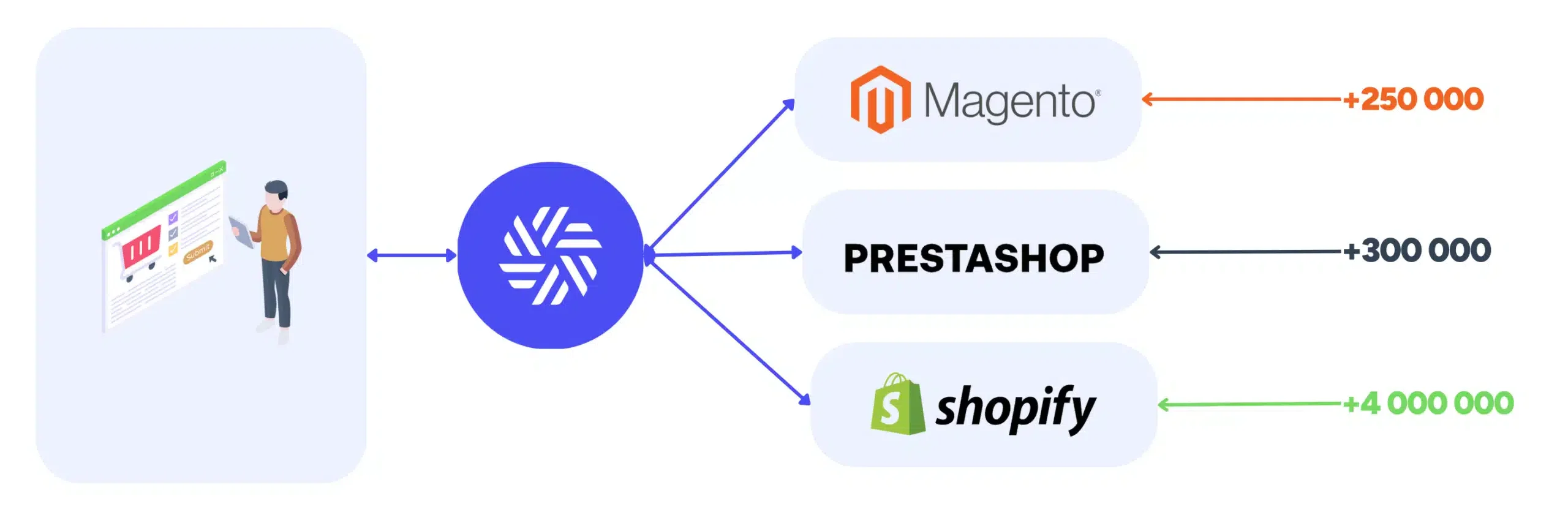
For an operator, Origami Link transforms seller recruitment: instead of convincing each seller to create a new account and manually import their catalogue, you offer them a connector they install in minutes from their Shopify or PrestaShop back-office. The barrier to entry collapses. See our article on marketplace connectors for technical details.
Channel 4: Partner network
Your technology partners (PSPs, integrators, e-commerce agencies) are in daily contact with e-commerce merchants. A partner programme with a referral fee can generate a steady flow of qualified sellers without direct acquisition cost.
Channel 5: Communities and events
LinkedIn industry groups, professional forums, networking events, trade associations. These channels work particularly well in B2B, where trust is built through proximity and word of mouth.
Channel 6: Viral recruitment (C2C)
In C2C, seller recruitment is inseparable from product marketing. Every buyer is a potential seller. Mechanisms that work: referrals (existing seller invites a new one), gamification (badges, levels, perks), and product virality (sharing a listing attracts new sellers through mimicry).
Ensure nothing is overlooked in your project specifications
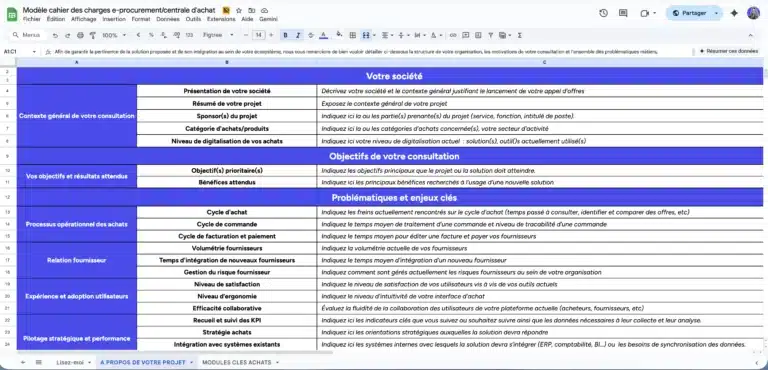
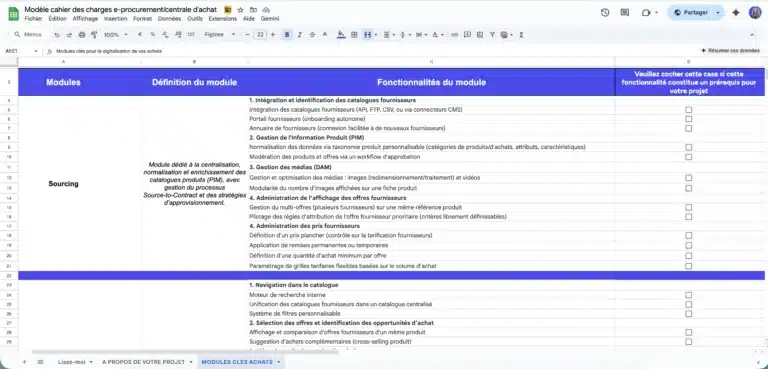
A ready-to-use template to quickly frame your e-procurement or purchasing group project, compare market solutions, and secure your vendor consultation process.
Comprehensive model used in B2C, B2B or C2C projects and ready to adapt.
3. Qualify and score sellers
Not every seller who shows up deserves the same investment. Qualification lets you prioritise your efforts and focus support on the highest-potential sellers.
Scoring criteria
| Criterion | What it measures | Suggested weighting |
|---|---|---|
| 📦Catalogue size | Number of available references | 15% |
| 🎯Category fit | Match with your priority categories | 20% |
| 💻E-commerce maturity | Already sells online (own site, other marketplaces) | 15% |
| 🚚Logistics capacity | Lead times, coverage zones, stock depth | 15% |
| ⭐Reputation | Customer reviews, ratings on other platforms | 10% |
| 📈GMV potential | Estimated transaction volume on your marketplace | 15% |
| 🔌Integration ease | Connector available, existing feed, API readiness | 10% |
Classify into 3 tiers
- Tier 1 (top sellers): score > 75/100. Proactive recruitment, personalised support, preferential commercial terms. These sellers will drive your GMV.
- Tier 2 (standard sellers): score 50-75. Semi-automated recruitment, standard onboarding, group support (webinars, documentation).
- Tier 3 (self-service sellers): score < 50. Self-registration, automated document validation, self-service support. High volume but lower unit value.
Track in a CRM
Every prospected seller should have a record in your CRM (HubSpot, Salesforce, Pipedrive, or even a structured spreadsheet at launch). Track the funnel: identified → contacted → qualified → negotiating → registered → activated. Without a CRM, you lose track after 30 prospects.
4. Convert: the arguments that tip the balance
A seller evaluates your marketplace on 5 criteria. Prepare a data-backed answer for each.
“How much will I sell?”
The number-one question. Prepare a pitch deck with your metrics: monthly unique visitors, active buyers, average order value, GMV by category. If you are pre-launch, show the potential: addressable market size, projected traffic, signed buyer pipeline.
“How much does it cost?”
Be transparent on your commission model. Compare your take rate to competitors. If you charge a subscription, justify the value delivered. Offer a welcome deal (reduced commission for the first 3 months, trial period) for Tier 1 sellers you absolutely want to recruit.
“Is it complicated to integrate?”
Show onboarding simplicity. If you have a connector like Origami Link (72-hour integration from Shopify/PrestaShop/Magento), lead with it. If you offer simple CSV import, show the template. If you have an API, show the documentation. Technical integration is the number-one friction point in B2B. See our article on Marketplace and API.
“Who buys on your marketplace?”
Describe your buyer base: sectors, company sizes, order frequency, typical baskets. In B2B, sellers want to know whether they will access buyers they could not have reached otherwise. That is the core value proposition.
“How are you different from Amazon/eBay?”
If you are a vertical or sector-specific marketplace, that is your strength: a qualified audience, a specialised catalogue, domain expertise. The seller will not be drowned in 10 million listings. See our marketplace strategy and best practices guide.
5. Accelerate onboarding with the right tools
The seller said yes. Every day between “yes” and the first sale increases the dropout risk. Onboarding must be fast, guided and as painless as possible.
The 3 catalogue import modes
- CSV/Excel import: the most accessible for sellers without e-commerce tooling. Provide a structured template with mandatory fields, expected formats and examples.
- CMS connector (Origami Link): for sellers on Shopify, PrestaShop or Magento. The catalogue syncs automatically, including stock and prices. Fastest and most reliable mode (72-hour average integration).
- API / EDI feed: for mature sellers with an ERP or PIM. Integration takes longer (2-4 weeks) but data quality is superior and synchronisation is real-time.
KYC/KYB verification
Before a seller publishes their first product, you must verify their identity and documents (business registration, VAT certificate, bank details, certifications). This is a regulatory obligation. Automate where possible: automatic company number verification, document upload in the back-office, automated reminders for missing documents. See our article on KYC and KYB for marketplaces.
Seller training
Never assume your interface is intuitive. Offer a quick-start guide (PDF or 5-minute video), a monthly group onboarding webinar and a dedicated contact for Tier 1 sellers. Target: the seller publishes their first products within 48 hours of account validation.
6. Activate: from registration to first sale
A registered seller who has never sold is worth nothing. Activation is the critical moment.
Boost new seller visibility
During the first 2 weeks, increase visibility for new sellers’ products: homepage featuring, priority placement in categories, dedicated buyer newsletter. The seller needs to receive their first orders quickly to enter a positive feedback loop.
Automated follow-up sequence
Set up an automated post-registration email sequence:
- D+1: welcome email with the quick-start guide.
- D+3: reminder if the catalogue is not yet published.
- D+7: offer individual support if the seller is not active.
- D+15: internal alert to the CSM if the seller still has not published.
- D+30: direct phone call.
A seller who completes their first sale within the first 15 days has a significantly higher retention rate than one who waits 30 days or more.
7. Retain to recoup the acquisition cost
Recruiting a seller costs 5 to 10 times more than retaining one. Every lost seller is wasted investment.
Retention levers
- Performance and revenue: the number-one lever. A seller who sells stays. Work on buyer acquisition and conversion so your sellers generate turnover.
- Ongoing support: dedicated account manager for Tier 1, quarterly performance reviews, catalogue optimisation suggestions.
- Progressive perks: reduced commission for sellers who exceed a GMV threshold, “premium seller” badge visible to buyers, early access to new features.
- Community building: private group (Slack, WhatsApp) for active sellers, dedicated events, best-practice sharing between sellers.
Monitor churn and its causes
Track seller churn monthly and distinguish involuntary churn (the seller leaves) from managed churn (you deactivate them). When a seller leaves, identify the cause: not enough orders? Commission too high? Interface too complex? Support issues? Each cause has a specific remedy. See our marketplace KPIs guide for the tracking framework.
8. Seller recruitment KPIs
| KPI | Formula / definition | Indicative benchmark |
|---|---|---|
| 💰Seller acquisition cost (SAC) | Recruitment budget / Activated sellers | B2B: EUR 500-5,000 B2C: EUR 50-500 C2C: EUR 1-20 |
| 🎯Funnel conversion rate | Activated sellers / Contacted sellers | 15-25% (outbound B2B) 5-10% (inbound) |
| ⏱️Time to activation | Days between registration and first sale | Target: < 15 days |
| 🚀30-day activation rate | Sellers with at least 1 sale / Registered sellers | > 50% |
| 📉Seller churn rate | Inactive sellers over 90 days / Total active sellers | < 10% per quarter |
| 📦Products per seller | Average catalogue per active seller | Varies by sector |
| ⭐Seller NPS | Net Promoter Score from sellers | > 30 |
Recruitment Dashboard
Your sales team should have a dashboard dedicated to seller recruitment, separate from the overall marketplace dashboard. This dashboard tracks the recruitment funnel (identified → contacted → qualified → registered → activated → retained) and helps identify bottlenecks at each stage of the process.
Conclusion
Seller recruitment is the growth engine of your marketplace. Whether you are building a B2B marketplace, a B2C multi-vendor platform or digitising your distribution network, our experts can help you structure your seller recruitment strategy.
Discover Origami Link, the marketplace connector for recruiting Shopify, PrestaShop and Magento sellers in 72 hours.
Let's talk about your project.
Let’s discuss it. our expertise extends beyond the tool as we help you structure your project with the right methodology to guarantee its success.

FAQ
No universal figure, but a rule of thumb: enough for a buyer to find what they need in your key categories. In B2B, 10 to 20 active quality sellers are sufficient. In generalist B2C, aim for 50 to 100. Never launch with an empty or near-empty catalogue: a buyer who finds nothing does not return. See our article on 8 fatal mistakes when launching a marketplace.
The chicken-and-egg problem. Arguments that work: exclusive access to a buyer segment (in B2B, your existing client network), free or reduced commission at launch, simple integration (Origami Link in 72 hours), and the promise of personalised support. Your first sellers are partners, not customers. Treat them accordingly.
No. A low-quality seller costs more than they generate: thin product listings, disputes, returns, brand damage. Implement a validation process (KYC/KYB, catalogue review, logistics capacity check) before going live. Your offer quality depends on your seller quality.
Do not position your marketplace against Amazon. Position it as a complement. The argument: “you are already on Amazon; add a sales channel in 72 hours with Origami Link, without re-entering your catalogue.” The marginal cost for the seller is near zero, the revenue potential is incremental.
At launch, a dedicated Seller Acquisition Manager is the minimum. This role combines prospection, negotiation and onboarding support. Beyond 50 active sellers, add a CSM (Customer Success Manager) for retention and ongoing support.
The mechanics are the same but the seller profile changes. On a service marketplace, the “seller” is a service provider. Qualification focuses more on skills, availability and coverage areas than on catalogue volume. Onboarding is more qualitative (provider profile, portfolio, references) and less technical (no catalogue import).