HomeBlogB2B e-procurement platformAgentic Commerce in B2B: When AI Does the Buying for You
Agentic Commerce in B2B: When AI Does the Buying for You
In 2026, a new paradigm is taking hold in B2B commerce. AI agents are no […]
Agentic Commerce in B2B: When AI Does the Buying for You
- Arnaud
- Estimated reading time: 15 minutes
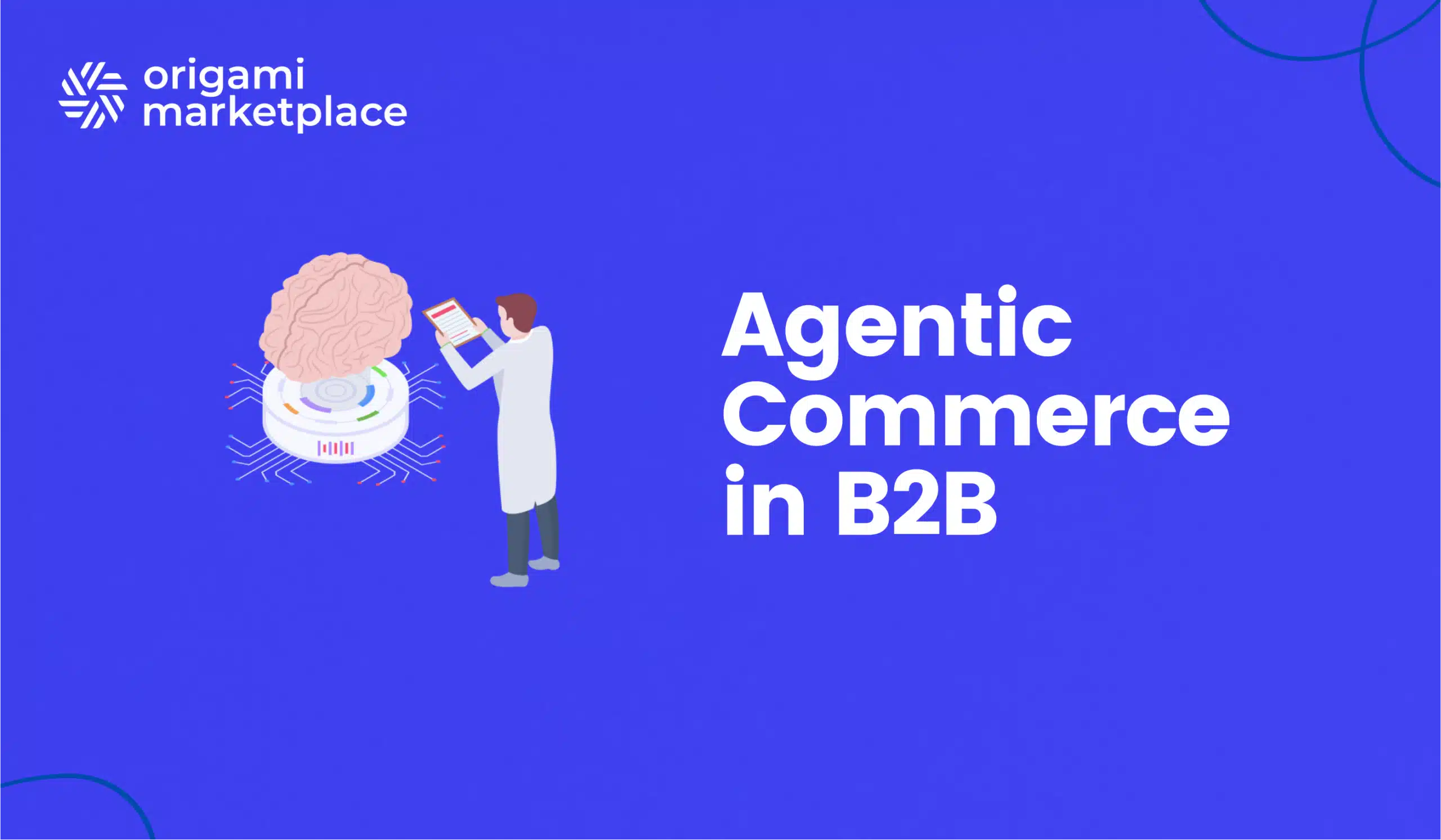
In 2026, a new paradigm is taking hold in B2B commerce. AI agents are no longer limited to recommending products. They search, compare, negotiate and place orders, with minimal human oversight. This shift has a name: agentic commerce.
This is not a theoretical concept. According to Gartner, 90% of all B2B purchases could be handled by AI agents by 2028, driving over $15 trillion through automated exchanges. Forrester predicts that by the end of 2026, 1 in 5 B2B sellers will face quote negotiations led by AI-powered buyer agents.
For B2B marketplace operators, this shift is both an opportunity and a challenge. Platforms that adapt to machine-to-machine interactions, in addition to human ones, will gain a significant competitive edge. Those that remain designed exclusively for a human behind a screen will gradually lose relevance.
This guide explores what agentic commerce is, what it concretely changes for B2B procurement and how to prepare your marketplace for this new reality.
Table of contents:
1. What is agentic commerce?
From chatbot to autonomous agent
Agentic commerce marks a break from the conversational AI tools we have known for the past few years. A chatbot answers questions. An AI assistant recommends products. An AI agent, however, acts: it interprets an objective, plans the steps to achieve it, executes actions across systems and adapts its strategy based on the results.
In practice, an AI purchasing agent can:
- Interpret a sourcing request expressed in natural language.
- Search for matching products across a marketplace catalogue.
- Compare offers from multiple suppliers (price, lead times, terms).
- Prepare an optimised quote or shopping cart.
- Submit the order for approval or place it directly if it falls within a predefined framework.
The difference from traditional automation
Procurement automation has existed for years through Procure-to-Pay workflows, automated replenishment rules and recurring orders. But these automations follow rigid, pre-programmed rules. An AI agent reasons: it understands context, handles exceptions and makes decisions within a defined delegation framework. Our article on procurement automation explores the evolution of these mechanisms, of which agentic commerce is the natural next step.
Why 2026 is the tipping point
Several factors are converging to make 2026 the breakout year for agentic commerce in B2B:
- LLM maturity (Large Language Models) enables agents to understand complex requests and reason over structured catalogues.
- Emerging standardised protocols (such as Google’s and OpenAI’s agentic purchasing protocols) are creating a technical framework for machine-to-machine transactions.
- Cost pressure on procurement is pushing purchasing departments to automate low-value transactional tasks.
- Widespread adoption of generative AI by B2B professionals, who already use ChatGPT, Copilot and similar tools in their daily work.
2. How AI agents are reshaping the B2B buying journey
Agentic commerce does not transform just one step of the buying journey. It transforms all of them.
Product search becomes conversational
Today, a B2B buyer navigates a catalogue, applies filters and scrolls through pages of results. With an AI agent, they describe their need in plain language: “I need chemical-resistant gloves, size L, EN 374 certified, deliverable within 48 hours to the Midlands.” The agent queries the catalogue, applies the criteria and surfaces the relevant results in seconds.
This conversational search is anchored in the marketplace’s real catalogue data. It is not a generic search engine: it is an assistant that knows your inventory, your stock levels and your terms. To understand the importance of catalogue data quality, see our article on how to create a product data sheet for your marketplace.
Replenishment becomes proactive
Instead of waiting for the buyer to remember to reorder, the AI agent analyses order history, detects consumption patterns and proposes a renewal at the right time. For recurring purchases (consumables, PPE, office supplies), this capability eliminates stockouts and drastically cuts the time spent on routine orders.
Quote requests become assisted
In B2B, quotes are everywhere. The AI agent can assemble a structured RFQ from a natural language description, a scanned purchase order or an imported Excel file. It identifies the matching products in the marketplace catalogue, pre-fills quantities and submits the request to the relevant suppliers. For more on quote management, see our guide on the Request for Quotation (RFQ) advantage for B2B marketplaces.
Supplier comparison becomes instant
The AI agent can compare, in real time, offers from multiple suppliers on the same product or requirement: unit price, total delivered cost, lead time, availability, performance history. In B2B, where the same product may be offered by five sellers with different terms, this capability is a major productivity gain.
Ordering becomes a validation act, not a data entry task
In the agentic model, the buyer no longer “places” an order. They validate an order prepared by the agent. The cart is pre-built, optimised (supplier grouping, adjusted quantities, best value-for-money) and presented for approval. The human buyer retains control of the final decision, but no longer wastes time on manual entry.
3. 5 concrete use cases for B2B marketplaces
Use case 1: Smart Reorder for recurring purchases
The AI agent identifies products regularly ordered by a buyer, calculates the optimal replenishment cycle and proposes a one-click renewal. The buyer receives a notification: “You ordered 500 nitrile gloves 45 days ago. Would you like to renew this order?” One click, and it is done.
This use case is particularly relevant for MRO (maintenance, repair, operations) procurement and indirect purchases, where the order processing cost often exceeds the product value. Our article on indirect procurement details the rationalisation potential.
Use case 2: AI-powered bulk order import
A buyer receives an internal purchase order as a PDF, an Excel file with a reference list, or even a photo of a handwritten table. The AI agent reads the document, identifies the products in the marketplace catalogue, reconstructs the cart and submits it for validation. What used to take an hour of manual entry is done in seconds.
Use case 3: AI-assisted sourcing
A procurement manager is looking for a new supplier for a product category. Instead of browsing the supplier directory, they describe their need to the agent: “I need a supplier of industrial cables, ISO 9001 certified, 72-hour delivery to our South East sites.” The agent queries the marketplace catalogue, filters eligible sellers and presents a shortlist with performance data (average lead time, dispute rate, buyer ratings). Our article on strategic sourcing via multi-supplier marketplace expands on this approach.
Use case 4: Visual search
The buyer does not know the exact reference of a part. They take a photo and submit it to the AI agent, which identifies the product in the catalogue through visual recognition and suggests matching results. This use case is particularly useful in industrial, maintenance or construction environments, where field operators need to order parts quickly without knowing the exact nomenclature.
Use case 5: AI-assisted quoting for sellers
Agentic commerce is not only about buyers. On the seller side, an AI agent can analyse incoming RFQs, check product availability, apply negotiated pricing terms and generate a ready-to-send quote. The sales team focuses on complex requests while the agent handles standard ones.
4. The AI buyer assistant: agentic commerce in action
The concept of agentic commerce can feel abstract. Here is what it looks like in practice when integrated into a B2B marketplace.
Origami Copilot: AI-powered buying experience
At Origami, we have developed Origami Copilot, an AI assistant designed for B2B buyers on marketplaces. This module integrates directly into your marketplace front office and gives your buyers a conversational assistant anchored in your real catalogue data.
What Origami Copilot does:
- Conversational AI chat: the buyer describes their need in natural language. The Copilot searches the marketplace’s actual catalogue, not a generic database, and returns matching products.
- One-click Smart Reorder: the agent analyses order history and proposes renewal of recurring purchases, with intelligent restocking alerts.
- Bulk order import: the buyer uploads a CSV, Excel, PDF or even an image. The AI identifies the products, rebuilds the cart and submits it for validation.
- AI-assisted RFQs: the Copilot helps the buyer formulate and structure quote requests, identifying the most relevant suppliers.
- Product comparator and visual search: instant multi-criteria comparison and product identification by photo.
Measured results
Early deployments of Origami Copilot show tangible outcomes:
- 90% reduction in product search time: conversational search is radically faster than filter-based navigation.
- 99% reduction in reorder time: Smart Reorder turns a 20-minute process into a single click.
- 25% increase in average basket size: the agent suggests relevant complementary products and optimises quantities.
- Under 5 minutes to go live: the module installs on your Origami front office with zero development required.
An accessible pricing model
Origami Copilot runs on a hybrid model: a monthly subscription (EUR 199/month) for the platform, plus AI usage billed on consumption. This makes it 10 to 30 times cheaper than traditional AI procurement SaaS solutions, which typically charge per-user licences or high annual fees.
5. What agentic commerce demands from your marketplace
Agentic commerce only works if your marketplace is ready to interact with AI agents. This imposes specific technical and structural requirements.
Structured, complete product data
An AI agent cannot reason on incomplete data. If your product listings lack normalised descriptions, structured technical attributes, up-to-date prices and reliable stock data, the agent will not be able to search or compare effectively.
Catalogue data quality is the foundation of agentic commerce. This is the time to invest in your B2B catalogue visibility and product referencing and to enforce quality standards for your sellers.
Open, documented APIs
AI agents interact with your marketplace through APIs, not through a graphical interface. Your platform must expose endpoints for product search, price and stock consultation, cart creation, order submission and delivery tracking. Our article on Marketplace and API covers the key integration points.
Approval workflows adapted for agents
Your marketplace’s approval workflows must be able to handle orders placed by an AI agent. This means: configurable validation thresholds (below X amount, the agent orders automatically; above, a human approves), a clear delegation system and full traceability of agent actions.
Machine-readable pricing
Complex pricing structures (volume discounts, customer-specific rates, contract-based terms) must be structured so that an AI agent can interpret and apply them. A PDF of commercial terms is not exploitable by an agent. A structured data set with explicit pricing rules is.
Ensure nothing is overlooked in your project specifications
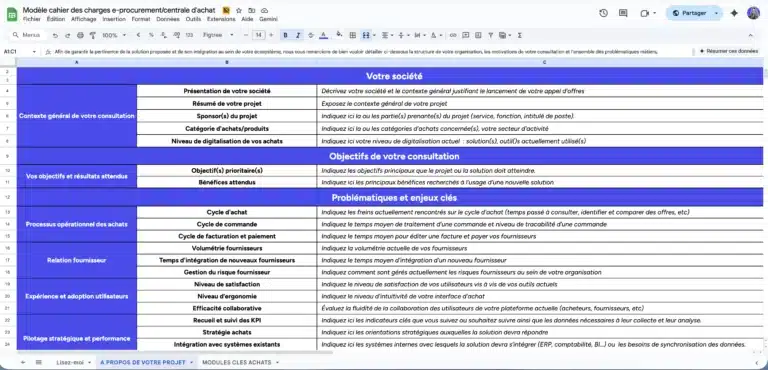
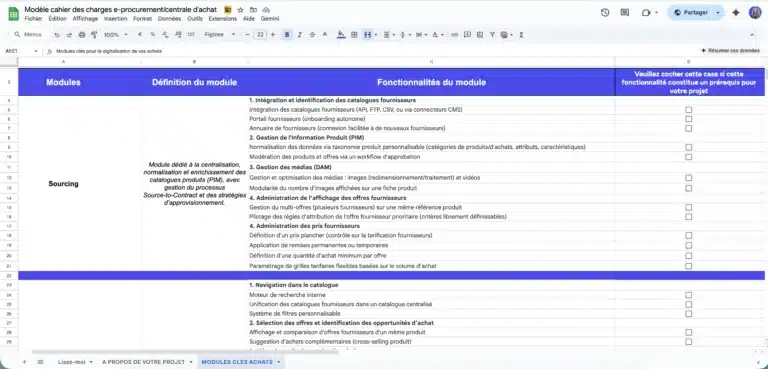
A ready-to-use template to quickly frame your e-procurement or purchasing group project, compare market solutions, and secure your vendor consultation process.
Comprehensive model used in B2C, B2B or C2C projects and ready to adapt.
6. Preparing your platform: 5 priority workstreams
Workstream 1: Audit and enrich your catalogue data
Review your product listing quality. Every product should have: a normalised title, a structured description with technical attributes, quality images, an up-to-date price, a real-time stock status and delivery information. AI can only reason on reliable data.
Workstream 2: Make your catalogue AI-ready
Beyond quality, structure your data for agent interpretability: consistent product taxonomy, normalised attributes per category, enriched metadata. This is what enables the agent to understand that “blue nitrile glove L EN 374” matches product XYZ in your catalogue.
Workstream 3: Expose transactional APIs
Ensure your marketplace exposes the necessary APIs: product search, availability, cart creation, order submission, tracking. If your platform runs on a headless or API-first architecture, you have a head start.
Workstream 4: Configure delegation rules
Define the boundaries within which an AI agent can act autonomously: maximum order value, authorised suppliers, covered product categories, replenishment frequency. These rules are the safety net that enables autonomy without risk.
Workstream 5: Integrate a native AI module
Rather than building your own AI layer, opt for a module integrated into your marketplace solution. Origami Copilot is designed to activate in minutes on an Origami front office, with zero development required. It is the fastest path to offering an agentic buying experience to your users.
7. Limitations and open questions
Agentic commerce is a structural trend, but it is important to maintain a clear-eyed view of its current limitations.
Trust in agent decisions
In B2B, a single order can commit thousands of pounds and contractual obligations. Entrusting such decisions to an AI agent requires a level of trust that organisations build progressively. Most companies start with low-risk use cases (consumable replenishment) before expanding the scope.
Legal liability
When an AI agent places an order, who bears legal responsibility? The buyer who configured the agent? The marketplace operator? The AI solution provider? The European regulatory framework (AI Act, applicable from August 2026) is beginning to set rules, but many grey areas remain.
Buyer adoption
The most digitally mature buyers (CIOs, innovation directors, large enterprises) will adopt agentic commerce quickly. More traditional buyers (SMEs, tradespeople, field purchasers) will need time and support. The coexistence of human and agentic buying journeys will be the norm for several years.
Market reality today
According to Deloitte, fewer than one quarter of B2B suppliers currently use agentic AI technologies. The market is in early adoption. This is precisely why platforms that invest now in this capability are building a competitive advantage: when adoption accelerates, they will be ready.
Conclusion
Agentic commerce is redefining the B2B buying experience. Whether you want to build your multi-vendor marketplace, digitise your group purchasing organisation or deploy an AI-augmented procurement solution, our experts can help you design a platform ready for tomorrow’s commerce.
Discover Origami Copilot, the AI assistant for your B2B buyers.
Do you want to build an agile and future-proof platform?
Let’s discuss it. our expertise extends beyond the tool as we help you structure your project with the right methodology to guarantee its success.

FAQ
No. The AI agent takes over transactional, repetitive tasks: search, comparison, replenishment, order entry. The human buyer focuses on strategic decisions: supplier selection, contract negotiation, relationship management. It is a division of value, not a replacement.
Ask yourself three questions: are your product listings complete and structured? Does your platform expose transactional APIs? Can your approval workflows handle automated orders? If you answer yes to all three, you have the foundations. If not, start with these workstreams.
E-procurement is the organisational and technological framework that structures enterprise purchasing. Agentic commerce adds an intelligence layer: instead of following rigid workflows, the AI agent understands context, handles exceptions and optimises decisions within the framework defined by the e-procurement system.
With a module like Origami Copilot, the cost is EUR 199/month plus AI usage on consumption. This is 10 to 30 times cheaper than traditional AI procurement SaaS solutions. The main prerequisite is not financial but qualitative: your catalogue data must be structured and up to date.
Yes, with adaptations. On a service marketplace, the AI agent can assist provider search, pre-qualify profiles based on requirements and structure RFQs. Smart Reorder applies to recurring services (maintenance, cleaning, temporary staffing). Comparison is more qualitative than with physical products, but the AI assistance still delivers real productivity gains.
Yes. The agent can integrate CSR criteria into its recommendations: prioritising local suppliers, eco-labelled products or recycled materials. These criteria are configurable by the operator or the buyer. Our article on responsible procurement via marketplace explores this dimension.