HomeBlogB2B e-procurement platformB2C online marketplaceBest PracticeMarketplace SLAs: Setting Service Levels for Your Sellers
Marketplace SLAs: Setting Service Levels for Your Sellers
One seller takes 6 days to ship. Another never replies to buyer messages. A third […]
Marketplace SLAs: Setting Service Levels for Your Sellers
- Arnaud
- Estimated reading time: 14 minutes
One seller takes 6 days to ship. Another never replies to buyer messages. A third posts product listings so sloppy that the return rate spirals. On your marketplace, these three sellers sit alongside your best performers, and your brand takes the hit.
The problem is not that these sellers exist. The problem is that nothing tells them what is expected, and nothing happens when they fall short.
That is what a SLA (Service Level Agreement) framework between the operator and sellers solves. Not a 40-page legal document nobody reads. An operational framework, measurable, with clear thresholds, real consequences and continuous monitoring.
Amazon enforces an ODR (Order Defect Rate) below 1%, a Late Shipment Rate under 4% and a 24-hour message response time. Cross those lines and the seller is suspended. Harsh, but it works: buyers trust the platform. You do not need to be as strict as Amazon, but you need a framework. This guide explains how to build one.
1. Why SLAs are your best quality tool
Your reputation depends on your worst sellers
A buyer who has a bad experience with a seller does not blame the seller. They blame the marketplace. “I ordered on [your marketplace] and it was awful.” That mental shortcut is universal. If you do not control your sellers’ service quality, every transaction is a reputational risk. SLAs set a floor below which no seller can drop without consequence.
B2B buyers demand it
In B2B, procurement teams ask the question in the first meetings: “How do you guarantee seller quality?” If you do not have a structured answer, you lose the deal. A documented SLA framework is a sales argument as much as an operational tool. For more on structured procurement expectations, see our article on procurement KPIs.
SLAs also protect your best sellers
Without a quality framework, your top sellers are lost in the crowd. They invest in complete product listings, ship on time, respond to messages, and nobody notices because the seller next door does whatever they want at the same visibility level. SLAs create a meritocracy: high performers are rewarded, the rest are pushed up or pushed out.
2. The 8 metrics to contractualise
You do not need 25 indicators. Eight metrics cover the essentials of service quality on a marketplace.
Metric 1: Order processing time
The time between order receipt and confirmation/shipment. This is the metric your buyers feel first. Amazon sets the acceptance threshold at 24 hours. In B2B, 48 to 72 hours for shipment is a reasonable standard, depending on logistics complexity.
Metric 2: On-time delivery rate (OTDR)
The percentage of orders delivered within the announced timeframe. Amazon formalised OTDR at 90% in September 2024, and it has since become the most heavily weighted shipping metric in their Buy Box algorithm. For your marketplace, aim for a minimum of 90% in B2C and 85% in B2B (where lead times are longer and logistics disruptions more common).
Metric 3: Order defect rate (ODR)
The percentage of orders that generate a problem: buyer complaint, open dispute, forced refund, negative review. Amazon sets the threshold at 1%, but top sellers operate below 0.3%. On your marketplace, 2% is a reasonable starting point. See our guide on handling disputes for how ODR connects to conflict resolution.
Metric 4: Message response time
The average time to first response to buyer messages (questions, complaints, RFQs). Amazon requires a response within 24 hours, weekends included. For a B2B marketplace, 24 business hours is a standard threshold.
Metric 5: Order acceptance rate
The percentage of orders confirmed by the seller (vs refused or cancelled). A seller who cancels 10% of their orders generates buyer frustration and wastes qualified traffic. Recommended threshold: > 95%.
Metric 6: Catalogue quality
A composite indicator: percentage of product listings that meet marketplace standards (normalised title, complete description, filled attributes, compliant images). Not a transactional SLA in the strict sense, but a measurable quality prerequisite. For the standards to enforce, see our guide on creating product data sheets.
Metric 7: Return and refund rate
The percentage of orders resulting in a return or refund. A high rate for a specific seller signals a product conformity or misleading description problem. Thresholds vary sharply by category (fashion: 20-30%, industrial: 2-5%), so set them per product family.
Metric 8: Document compliance
Are the seller’s documents current? Business registration, certifications, insurance, VAT attestation. A binary indicator (compliant / non-compliant) but an eliminating one. A seller with expired documents should not be allowed to sell. See our article on KYC and KYB for marketplaces.
Ensure nothing is overlooked in your project specifications
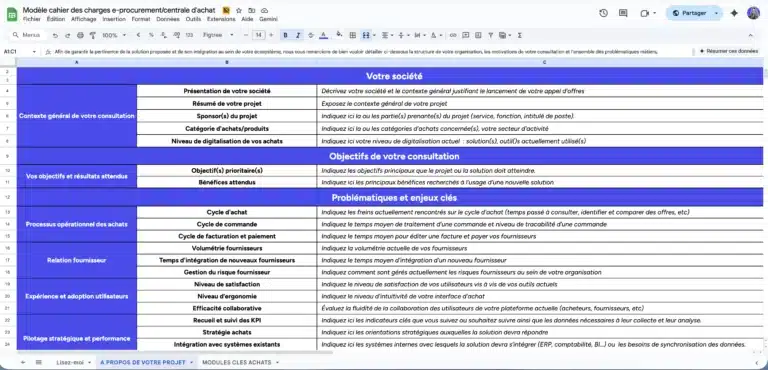
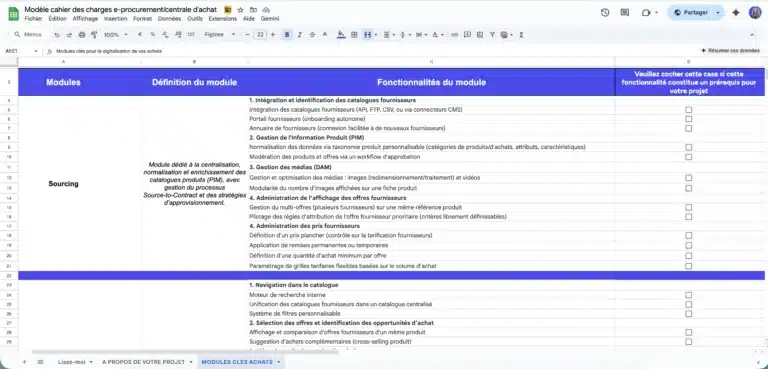
A ready-to-use template to quickly frame your e-procurement or purchasing group project, compare market solutions, and secure your vendor consultation process.
Comprehensive model used in B2C, B2B or C2C projects and ready to adapt.
3. Setting the right thresholds (without copying Amazon)
Amazon can afford to suspend a seller at 1% ODR because it has 2 million sellers queuing up. You probably do not. Setting thresholds too tight at launch risks deactivating sellers you need. Setting them too loose means controlling nothing at all.
The progressive method, work in three phases:
- Phase 1 (launch, 0-6 months): set soft, educational thresholds. The goal is to establish the framework and collect data. Notify sellers who exceed thresholds, without sanctions. You learn what your sellers are capable of.
- Phase 2 (growth, 6-18 months): tighten thresholds based on collected data. Look at the 75th percentile of your sellers on each metric and set the threshold slightly above. Introduce the first sanctions (visibility restriction, warning).
- Phase 3 (maturity, 18 months+): align your thresholds with market best practices. Introduce suspension and delisting for persistent cases. Good sellers will not be affected; poor ones will have had time to adapt.
| Metric | Market standard (B2C) | Market standard (B2B) | Amazon (benchmark) |
|---|---|---|---|
| Shipping time | 48h | 72h | 24h (acceptance) |
| On-time delivery rate | > 90% | > 85% | > 90% (OTDR) |
| Order defect rate | < 3% | < 2% | < 1% (ODR) |
| Message response time | < 24h | < 24h business | < 24h (7 days) |
| Order acceptance rate | > 95% | > 95% | > 97.5% |
| Return rate (category dependent) | < 10% | < 5% | Varies |
4. Formalising SLAs in your seller agreements
SLAs should appear in your seller terms of service or in a dedicated “Seller quality charter” annex. The key is that the seller accepts them during registration.
What the document must contain
- The list of tracked metrics, with a clear definition of each.
- The expected thresholds, expressed as numbers (not “the seller must be responsive”, but “the seller must respond within 24 business hours”).
- The consequences for threshold breaches, formulated progressively (notification, warning, restriction, suspension, termination).
- The measurement frequency (monthly, weekly, real-time).
- The reinstatement conditions: how a suspended seller can regain their status.
Make SLAs visible to the seller
Do not hide your SLAs in a 40-page PDF. Integrate a SLA dashboard in the seller back-office, where each seller sees their metrics in real time, their current status (green / amber / red) and the distance to each threshold. That is the most effective self-regulation lever.
5. Managing SLAs day to day
The operator dashboard
Your operator back-office must centralise SLA metrics for all sellers in a single dashboard. Essential capabilities:
- Aggregate view: averages, medians, distribution by tier.
- Per-seller view: individual metrics for each seller.
- Automatic alerts: notification when a seller exceeds a threshold.
- History: metric trends over time to spot patterns.
See our marketplace KPIs guide for a broader view of performance indicators.
The monthly seller review
Once a month, review the SLA dashboard with your operations team. Identify sellers on alert, trends (improvement or decline) and actions to take. For strategic sellers, a quarterly individual check-in strengthens the relationship and creates space for constructive exchange.
Automating alerts and actions
Manual alerts do not scale. Beyond 50 sellers, automate: notification to the seller when a metric turns amber, formal warning email when it turns red, automatic visibility restriction for persistent breaches. Your marketplace’s automated workflows are the right tool for this.
6. Corrective actions: support before sanctions
A seller who exceeds a SLA threshold is not necessarily a bad seller. They might be handling a demand spike, dealing with a temporary logistics issue or simply not understanding what is expected. Immediate sanctions are counterproductive if they cost you a recoverable seller.
Apply a progressive escalation:
- Level 1: Notification. The seller receives a factual email: “Your on-time delivery rate dropped to 82% this month (expected threshold: 90%). Here are the orders concerned.” No threat, just a data-driven observation.
- Level 2: Improvement plan. If the metric does not improve after 30 days, offer support: training, logistics process review, adjustment of announced lead times. This is a hand extended, not a warning.
- Level 3: Formal warning. If the improvement plan has no effect after 60 days, issue a written warning with a compliance deadline (30 days) and the consequences of non-compliance.
- Level 4: Visibility restriction. The seller’s products are demoted in search results. The seller loses exposure but remains active. A strong signal without a full break.
- Level 5: Temporary suspension. The seller account is deactivated until compliance is restored. The seller retains their data and can be reactivated.
- Level 6: Termination. As a last resort, the seller is removed from the platform.
Reward high-performing sellers
The other side of SLAs: reward sellers who consistently perform above thresholds. “Premium seller” badge visible to buyers, visibility boost in search results, access to exclusive features, reduced commission rate. See our article on marketplace commissions for seller retention levers.
7. SLAs for group purchasing organisations
If you operate a group purchasing organisation or a multi-entity procurement platform, SLAs take on a reinforced contractual dimension.
SLAs as a listing condition
In a GPO, the supplier is listed after a formal selection process. SLAs can form part of the initial listing criteria: the supplier commits to service levels before they start selling. Non-compliance with SLAs becomes grounds for delisting.
SLAs negotiated via framework contracts
Service conditions can be negotiated supplier by supplier within framework agreements. A strategic supplier may have stricter SLAs (in exchange for guaranteed volume) or more flexible ones (because their expertise is irreplaceable). The marketplace must support this granularity.
SLAs and responsible procurement
Procurement teams increasingly integrate CSR criteria into SLAs: subcontractor payment terms, delivery carbon footprint, material sourcing. These extra-financial criteria are not yet standardised, but they are gaining weight in tender processes. See our article on responsible procurement via marketplace for this dimension.
Conclusion
SLAs are the foundation of service quality on your marketplace. Whether you are building a B2B marketplace, digitising your group purchasing organisation or deploying a service marketplace, our experts can help you define a SLA framework adapted to your market.
Let's talk about your project.
Let’s discuss it. our expertise extends beyond the tool as we help you structure your project with the right methodology to guarantee its success.

FAQ
Not in their full form. At launch, set the framework: list the metrics, communicate expectations, start collecting data. Sanctions come when you have enough insight to set realistic thresholds. But do not launch with nothing: a seller who develops bad habits in the first months will be very hard to correct later.
Yes, if they are embedded in your seller terms of service or a listing agreement signed by the seller. Thresholds, consequences and procedures must be stated clearly and unambiguously. Have a legal professional review the drafting.
This is the hardest case. A seller who represents 15% of your GMV cannot be treated like one at 0.5%. Prioritise individual support: regular check-ins, root cause identification, joint action plan. Suspension is a last resort when buyer impact becomes untenable. But do not make exceptions on measurement: the data must be the same for everyone.
Your marketplace solution should natively track seller metrics (processing time, dispute rate, response time). Alerts and corrective actions (notification, visibility restriction) should be automatable via no-code configurable workflows.
The metrics change, but the principle stays the same. On a service marketplace, “shipping time” becomes “service initiation time”. “Return rate” becomes “post-service complaint rate”. Buyer satisfaction carries even more weight, because a service is inherently more subjective than a physical product.