HomeBlogBest PracticeGEO for Marketplaces: How to Get Cited by AI
GEO for Marketplaces: How to Get Cited by AI
60% of US shoppers already use AI during their purchasing journey and that traffic converts: […]
GEO for Marketplaces: How to Get Cited by AI
- Arnaud
- Estimated reading time: 14 minutes
60% of US shoppers already use AI during their purchasing journey and that traffic converts: visitors from ChatGPT show a 31% higher conversion rate than non-branded organic traffic (Visibility Labs, 94 e-commerce sites, 2025).
For a marketplace operator, these numbers raise a direct question: when a buyer asks ChatGPT “what is the best supplier of chemical-resistant gloves in the UK?”, does your marketplace appear in the answer? And when Google AI Overviews synthesises a response above the organic results, is your category page cited as a source?
If the answer is no, you are losing an acquisition channel with exponential growth. The good news: the levers to fix this are identified. That is what GEO (Generative Engine Optimisation) is about.
1. GEO, LLMO, AEO: what are we actually talking about?
Three acronyms, one objective
The ecosystem has produced several terms to describe the same discipline:
- GEO (Generative Engine Optimisation): optimising content to be cited by generative search engines (Google AI Overviews, Perplexity, ChatGPT Search).
- LLMO (Large Language Model Optimisation): optimising visibility in LLM responses (ChatGPT, Claude, Gemini, Copilot).
- AEO (AI Engine Optimisation): an umbrella term covering both.
In this article, we use GEO as the unifying term. The goal remains the same: getting your marketplace cited when an AI agent answers a query related to your offering.
The fundamental difference from traditional SEO
In SEO, you optimise to appear in a list of links. The user clicks (or not) on your result. In GEO, your content is extracted, reformulated and presented within the AI’s response. You are no longer seeking a click from a list: you are seeking a citation in a synthesised answer. The selection mechanism differs, quality signals are weighted differently, and the content format that performs is different.
This does not mean SEO is dead. On the contrary: in May 2025, Google published an official guide on optimising for generative AI features in Google Search that confirms SEO fundamentals remain the foundation of AI visibility. But SEO alone is no longer enough. For the traditional SEO levers applied to marketplaces, see our article Marketplace SEO: 10 levers to rank your category pages.
2. What Google says (and what to ignore)
Google’s official guide on optimising for generative AI in Google Search is clear on several points:
What matters:
- Google’s generative AI features (AI Overviews, AI Mode) are built on classic ranking and quality systems. They use RAG (Retrieval-Augmented Generation) to extract content from Google’s index.
- SEO best practices remain the foundation: clean technical structure, useful and reliable content, strong E-E-A-T signals.
- Content should be organised for human readers: paragraphs, sections, clear headings. AI benefits from the same structure as your visitors.
- High-quality images and videos increase opportunities to appear in AI responses (multimodal experiences).
What to ignore:
- Google states explicitly: there is no special schema markup for AI. No hidden tag, no secret format. Structured data remains useful for classic rich results, but there is no “GEO hack” via schema.
- Google discourages artificial content “chunking” (slicing articles into micro-blocks for AI extraction).
- Google discourages creating dedicated AI files (like llms.txt) and pursuing inauthentic mentions.
- Google recommends prioritising proven SEO strategies over “AEO/GEO hacks”.
The core message: do good SEO, create expert, unique content, and you will naturally be visible in Google Search’s AI features.
Ensure nothing is overlooked in your project specifications
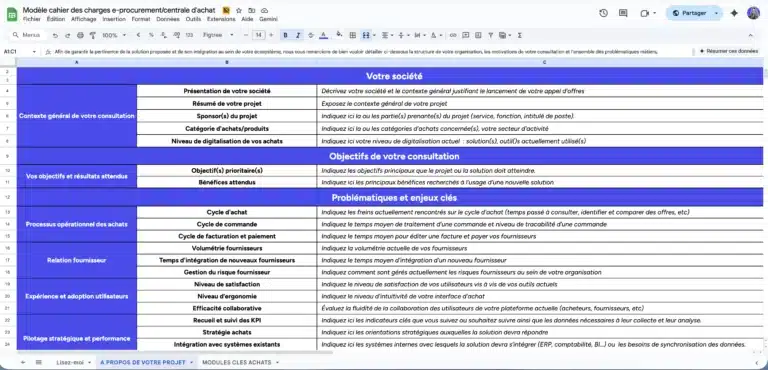
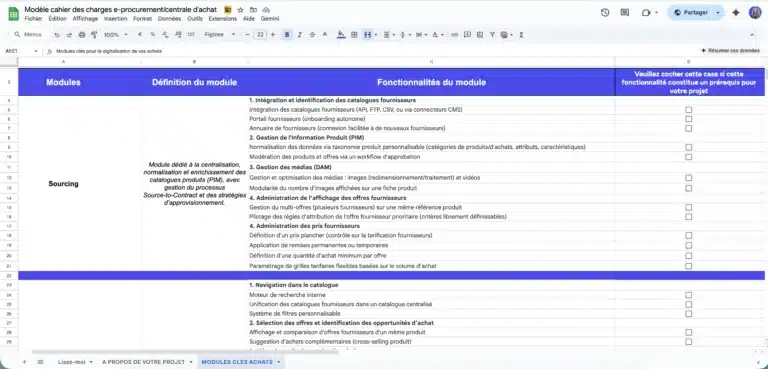
A ready-to-use template to quickly frame your e-procurement or purchasing group project, compare market solutions, and secure your vendor consultation process.
Comprehensive model used in B2C, B2B or C2C projects and ready to adapt.
3. How AI citations work across ChatGPT, Claude and Perplexity
Google is not the only player. Standalone LLMs (ChatGPT, Claude, Perplexity, Copilot) have their own citation mechanisms, and they generate measurable commercial traffic.
| Artificial Intelligence | Impact on traffic and conversion |
|---|---|
| 💬ChatGPT The AI referral heavyweight |
It represents the largest volume of AI-referred traffic to e-commerce sites. According to Similarweb (August 2025 data), ChatGPT already drives 20% of Walmart's referral traffic and over 20% of Etsy's. ChatGPT traffic converts at 1.81% vs 1.39% for non-branded organic, a 31% increase (Visibility Labs, 94 e-commerce sites, 2025). The explanation: users refine their need within the ChatGPT conversation before clicking. When they reach your product page, they are closer to purchase than a Google visitor still in comparison mode. |
| 🧠Claude Low volume, record conversion |
According to Elogic Commerce data (Q2 2026), Claude shows the highest conversion rate of any LLM platform at 16.8%. Anthropic's daily active user share went from under 2% to 10% in three months (Apptopia). Specificity: The typical Claude user profile is B2B, technical, high purchase intent. For a B2B marketplace, being cited in Claude's responses is an underrated conversion lever. |
| 🔍Perplexity The conversational search engine |
Perplexity functions as a search engine that systematically cites its sources. Every response includes links to the pages used for synthesis. Advantage: It is the most "SEO-friendly" LLM: if your content is well-structured and authoritative, Perplexity will cite it naturally. |
Attribution is broken (and it matters)
According to Elogic Commerce, 70.6% of AI referral traffic is invisible in standard GA4 setups: paid ChatGPT accounts do not pass referrer data, Gemini in Deep Research mode does not either. Actual AI referral traffic is likely 3 to 4 times higher than what your analytics show. Many users get a recommendation from ChatGPT, then search for the brand or product on Google. The conversion is attributed to “branded organic” when it was initiated by AI.
4. The 7 GEO levers for a marketplace
Lever 1: Create expert, non-generic content (E-E-A-T)
LLMs prioritise citing content that demonstrates verifiable expertise. An article that reformulates what everyone else says will not be cited. An article that brings proprietary data, sector-specific analysis or first-hand operational experience has far better citation odds.
For a marketplace: publish sector-specific buying guides written by domain experts, comparisons with precise technical criteria, market studies with original data. Add author bios with verifiable qualifications.
Lever 2: Structure content as direct answers
Google AI Overviews typically extract a 50-70 word block that directly answers the query. Structure your pages so that each section opens with a concise answer to an implicit question, followed by the detail.
Format that works: an H2 phrased as a question, followed by a 2-3 sentence paragraph that gives the answer, then the elaboration. This is the “inverted pyramid” model adapted for GEO.
Lever 3: Structure product data for AI agents
This is the marketplace-specific lever. Your product listings and category pages must contain data that is structured, normalised and API-accessible.
An AI agent searching for “nitrile gloves EN 374 48h delivery” needs:
- Attributes in dedicated fields (not buried in free text).
- Machine-readable pricing (not a PDF of commercial terms).
- Real-time stock levels.
- Queryable APIs.
See our article on Product Data Management (PDM) and PIM for how to structure this approach.
Lever 4: Invest in multimodal content (images, videos, tables)
Google confirms that AI Overviews incorporate images and videos in their responses. Comparison tables are particularly effective: LLMs extract them easily and reuse them in their syntheses.
For a marketplace: create product comparison tables by category, high-quality visuals with descriptive alt text, short product videos.
Lever 5: Build topical authority (content clusters)
LLMs assess a site’s authority on a topic by analysing the depth and consistency of its coverage. A standalone article carries less weight than a cluster of 10 interlinked articles on the same subject.
For a marketplace: build thematic clusters (e.g. “indirect procurement”: pillar article + sub-articles on class C purchases, TCO, automation, KPIs). Internal linking between articles reinforces the topical authority signal.
Lever 6: Update content regularly
AI systems favour recent content. A page updated in 2026 with current data will be cited ahead of a 2023 page with the same information. Refresh your key articles every 3 to 6 months: new statistics, new regulations, new use cases.
Lever 7: Be present across multiple surfaces (multi-channel distribution)
LLMs ingest information from across the web: articles, videos, podcasts, forums, social media. The more your brand is mentioned on diverse, credible sources, the more LLMs consider it a reference. This is the natural extension of link building: instead of targeting backlinks for PageRank, you target qualified mentions for LLM visibility.
5. GEO and product data: the core battleground
Why marketplaces have a structural advantage
A marketplace holds a rich, structured product catalogue that is continuously updated by its sellers. That is exactly the type of data AI agents exploit to answer transactional queries (“what is the best X for Y?”, “compare A and B”, “find a supplier of Z”).
The Catalogue Quality Score as a GEO indicator
The percentage of complete product listings (attributes filled, compliant images, structured descriptions) is a direct indicator of your GEO potential. An “AI-ready” catalogue is one where every listing can be interpreted unambiguously by an AI agent.
See our marketplace KPIs guide for how to integrate this metric into your dashboard.
Origami Copilot: AI on the buyer side
Origami Copilot is a conversational AI assistant integrated into your marketplace front office. It enables buyers to search your real catalogue in natural language, renew orders in one click and import bulk orders. Copilot is also a GEO signal: a marketplace that integrates AI into the buying experience produces more structured content, richer interactions and usage data that reinforces quality signals.
6. Measuring AI visibility
What is measurable today
- Google Search Console: displays impressions linked to AI Overviews (since 2025). Use this data to identify which pages are cited and on which queries.
- AI referral traffic in GA4: filter by source (chat.openai.com, perplexity.ai, claude.ai). Note: this traffic is under-reported by a factor of 3-4x.
- Manual testing: query ChatGPT, Perplexity and Claude with your market’s key queries and check whether your marketplace is cited.
- Post-purchase surveys: add a “How did you discover our marketplace?” question with “AI assistant (ChatGPT, etc.)” as an option.
What is not yet measurable
There is no standardised “GEO Score” yet, nor a Google Search Console for third-party LLMs. The tooling ecosystem is under construction. In the meantime, manual monitoring and post-purchase surveys remain the most reliable approaches.
Conclusion
GEO is a competitive advantage for marketplaces that prepare now. Whether you want to build your B2B marketplace, your B2C multi-vendor platform or structure your catalogue data for agentic commerce, our experts can help.
Let's talk about your project.
Let’s discuss it. our expertise extends beyond the tool as we help you structure your project with the right methodology to guarantee its success.

FAQ
No. Google is categorical: its AI features in Search are built on classic ranking systems. GEO does not replace SEO; it layers on top. A site poorly optimised for SEO will also have poor visibility in AI Overviews.
Google explicitly discourages this in its official guide. There is no special file, no secret schema, no technical shortcut. The best lever remains expert, structured, up-to-date content.
Test manually: ask ChatGPT your market’s main queries and check whether your marketplace appears. On the analytics side, filter referral traffic from chat.openai.com in GA4. Add a post-purchase survey to capture AI-attributed conversions.
The available data confirms it. The Visibility Labs study (94 e-commerce sites, 2025) shows a ChatGPT conversion rate of 1.81% vs 1.39% for non-branded organic (+31%). The explanation lies in intent compression: users refine their need in the AI conversation before clicking, so they arrive more qualified.
In B2B, GEO drives awareness and lead generation (a procurement director asking ChatGPT “which B2B marketplace solutions for indirect procurement?” is a warm lead). In B2C, GEO directly impacts sales through AI-generated product recommendations and comparisons. Both segments benefit from catalogue data quality as a visibility driver.
Ask yourself: do your product listings have attributes in structured fields (not in free text)? Are your prices API-queryable? Are your stock levels updated in real time? If the answer to any of these is no, your catalogue is not yet “AI-ready”. See our article on AI applications in marketplaces for how to structure your approach.