HomeBlogB2B e-procurement platformB2C online marketplaceBest PracticeBusiness modelC2C platformsNewsHow to build a marketplace: The ultimate 10-Step guide
How to build a marketplace: The ultimate 10-Step guide
Online marketplaces now make up a large and still-growing slice of digital commerce. According to […]
How to build a marketplace: The ultimate 10-Step guide
- Arnaud
- 12 minutes reading
Online marketplaces now make up a large and still-growing slice of digital commerce. According to Digital Commerce 360’s Global Online Marketplaces Database, the top 100 online marketplaces worldwide generated $3.832 trillion in Gross Merchandise Value (GMV) in 2024, up 10.0% year over year and roughly double what they generated just six years earlier (Digital Commerce 360, “Top Global Online Marketplaces: Key Data and Statistics,” updated April 2024).
If you’re considering building a marketplace, this guide covers what a marketplace actually is, why the model works, and the concrete steps to launch one, with real, sourced numbers instead of generic claims.
1. What is an online marketplace?
An online marketplace is a platform that connects buyers and sellers to facilitate transactions, without the platform itself owning the inventory it lists. It acts as an intermediary: sellers list products or services, buyers browse and purchase, and the platform earns revenue from the transaction, typically through commissions, subscriptions, or listing fees, rather than from buying and reselling stock itself.
This asset-light structure is what separates a marketplace from a traditional retailer. Amazon’s third-party marketplace, Alibaba’s Taobao and Tmall, Airbnb, and Vinted are all built on this model, even though they operate in very different categories: general retail, travel, and secondhand fashion, respectively.
« A marketplace can be compared to a shopping mall. Sellers rent space to showcase their products and handle their own stock and delivery, while the marketplace operates the building and takes a share of each sale made within it. »
Alexandre Duquenoy
→ Talk to our solutions expert
2. Why build an online marketplace?
The market is large and still growing. The top 100 global marketplaces reached $3.832 trillion in GMV in 2024, up from $2.670 trillion in 2020, according to Digital Commerce 360. That’s a measured trend based on actual sales, not a projection.
A handful of players still dominate, which is exactly why niche and regional marketplaces have room to grow. In 2023, China’s Taobao and Tmall (both Alibaba) and JD.com alone accounted for 62% of third-party sales among the top 100 global marketplaces, with Amazon ranked third globally at $435.7 billion in third-party sales (Digital Commerce 360). That concentration at the top suggests horizontal, everything-marketplace competition is largely settled. It also means specialized, vertical marketplaces focused on a single category, region, or audience face far less direct competition from the giants.
Network effects compound. Each new seller makes the platform more useful to buyers, and each new buyer makes it more attractive to sellers. Once that flywheel starts turning, it’s hard for a new entrant to replicate.
Revenue models are diversified and proven. Most marketplaces combine commissions on transactions, seller subscriptions, listing fees, and advertising. More on choosing one in Step 3 below, and in our dedicated guide to marketplace take rates.
Capital efficiency. Because marketplaces don’t hold inventory, they typically scale with lower working-capital needs than a retailer carrying stock. That’s one reason the model has attracted sustained investor interest over the past decade.
3. Types of online marketplaces
Marketplaces are usually classified along two axes: who is transacting, and how broad the catalog is.
By participants:
- B2B: businesses selling to businesses, e.g. Alibaba for bulk and wholesale trade
- B2C: businesses selling to individual consumers, e.g. AliExpress, Booking.com
- C2C: individuals selling to individuals, e.g. Vinted, Etsy
- Services / P2P: individuals or businesses offering expertise or labor, e.g. Upwork, Malt
By scope:
- Horizontal marketplaces cover many categories at once, like general retail or classifieds.
- Vertical marketplaces focus on one category or audience, such as Airbnb for short-term stays or Vinted for secondhand fashion. They often out-compete horizontal players within that niche because every feature is built around one specific buyer and seller need.
4. Case study: how Vinted turned a wardrobe clear-out into a €10.8bn GMV business
Vinted is a useful real-world example because its numbers are public and audited, not marketing claims.
Vinted was co-founded in 2008 by Milda Mitkutė and Justas Janauskas in Vilnius, Lithuania. The idea started small. Mitkutė was moving house and wanted an easy way to sell clothes she no longer needed, and Janauskas built the website that let users trade items directly with each other.
Nearly two decades later, the numbers behind that simple idea are substantial. According to Vinted’s own 2025 financial results, the platform’s GMV grew 47% year-over-year to €10.8 billion in 2025, generating €1.1 billion in revenue and €62 million in net profit (Vinted Group newsroom, “Financial results 2025”). In April 2026, a secondary share sale valued the company at €8 billion (Drapers, April 2026). The platform now operates in more than 26 markets across Europe.
The takeaway for anyone building a marketplace: Vinted didn’t set out to out-build Amazon. It picked one underserved, specific problem, peer-to-peer secondhand clothing resale, and optimized relentlessly for that single use case. That’s the vertical-marketplace advantage described above, in practice.
5. How to build a marketplace in 10 steps
Step 1: Identify market demand
Before building anything, confirm the demand is real.
- Study category trends. Is the underlying market (secondhand, B2B procurement, a specific service category) growing or shrinking?
- Talk to potential sellers first. A marketplace with no supply is just a website. Sellers are usually harder to recruit than buyers, so validate that side of the model early.
Step 2: Define your target audience
- Identify who you’re building for on both sides of the transaction. Buyers and sellers have different needs.
- Study how competitors, direct or adjacent, already serve this audience, and where the gaps are.
- Use search and content data to see what your audience is actually asking about. This is exactly the kind of analysis that should inform your own site’s content strategy, not just your product.
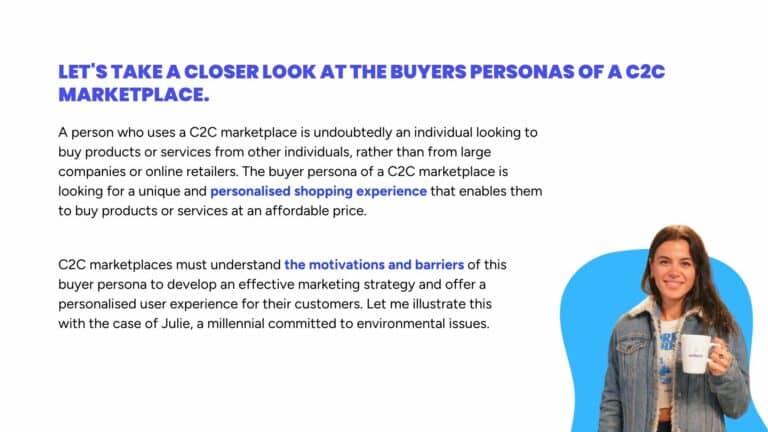
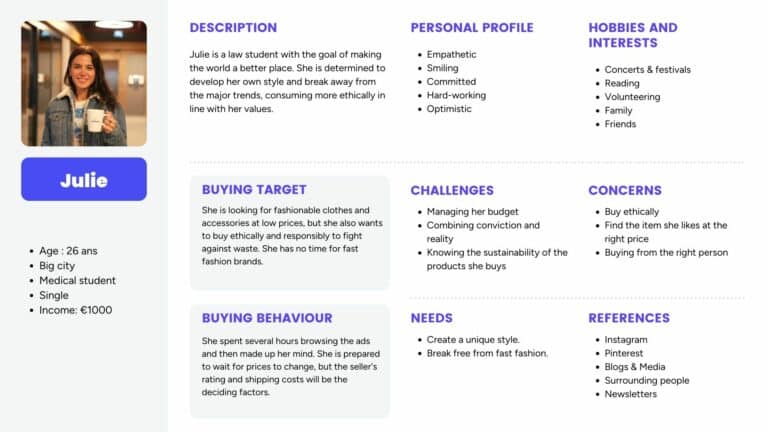
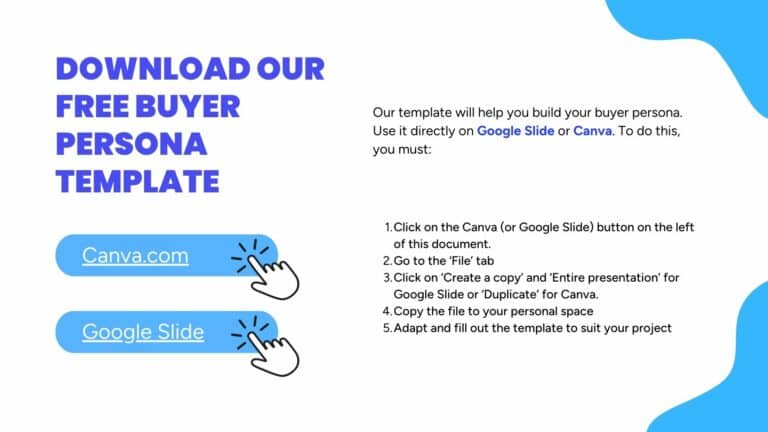
How do you define the buyer persona of your online marketplace?
Defining your buyer persona is the foundation of your strategy. Discover our best tips, a complete example, and a template to fill out.


Step 3: Choose your revenue model
Common options, often combined:
- Commission on transactions. The most common model; see our guide to marketplace take rates for how commission structures typically work.
- Seller or buyer subscriptions for recurring access or premium placement.
- Listing fees charged per item or service posted.
- Advertising, where sellers pay for visibility within the platform.
There’s no universal “right” rate. It depends on category margins, transaction frequency, and what competitors already charge in your vertical.
Step 4: Select your business model (B2B, B2C, C2C, or services)
Revisit the categories from the “Types of marketplaces” section above and pick the one matching your audience and supply side. This decision shapes almost everything downstream, from payment compliance requirements to trust-and-safety needs.
Step 5: Determine essential features, including how you’ll handle payments
Core features most marketplaces need on day one:
- User profiles for buyers and sellers
- Search and filtering
- Product/service listings with images and descriptions
- Reviews and ratings
- Messaging between users
- Secure checkout and order tracking
- Customer support and dispute handling
Payments deserve their own line item, because this is where most first-time marketplace builders underestimate the work. Unlike a standard e-commerce checkout, a marketplace involves three parties in every transaction: buyer, seller, and you as the operator. In most jurisdictions, you cannot simply collect and hold sellers’ funds yourself. You’ll typically need a licensed Payment Service Provider (PSP) that supports marketplace-specific “split payment” flows: automatically routing the seller’s share, retaining your commission, and handling KYC (know-your-customer) checks on sellers. In the EU and UK this also means accounting for PSD2 requirements. Choosing a PSP that supports marketplace payment splitting from day one avoids a costly migration later.
Advanced features worth planning for, though not necessarily building first, include AR product visualization, image-based search, and AI-assisted recommendations.
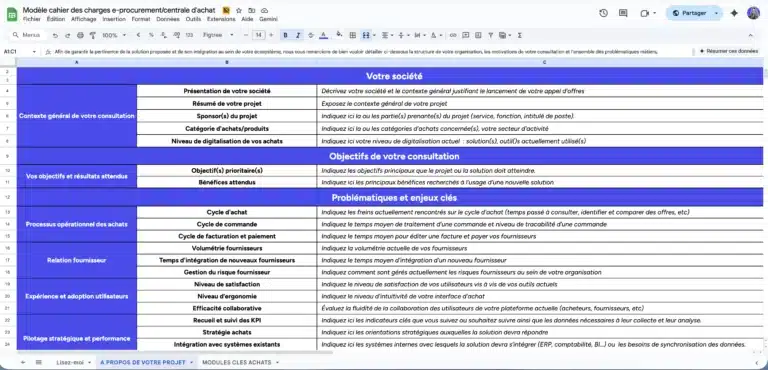
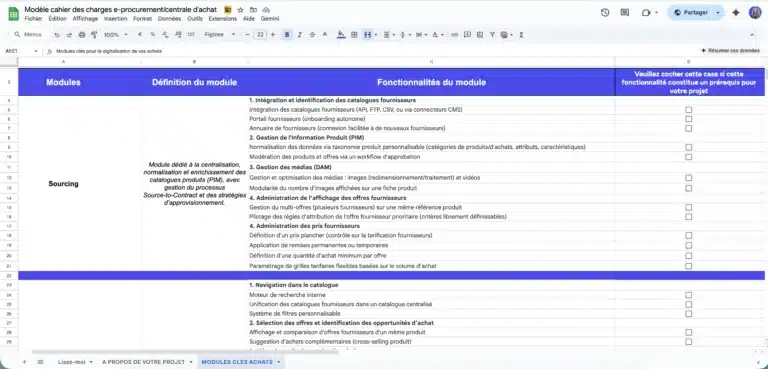
See the full feature checklist if you want the complete list, or download our marketplace specifications template to scope your own build.
Download our free marketplace specifications template.


A ready-to-use template to quickly frame your e-procurement or purchasing group project, compare market solutions, and secure your vendor consultation process.
Comprehensive model used in B2C, B2B or C2C projects and ready to adapt.
Step 6: Assemble your team
- Full-time hires for long-term ownership of the platform.
- Freelancers or an agency for flexibility on a fixed scope.
- Staff augmentation to add specialist skills temporarily.
A SaaS marketplace platform reduces how many of these roles you need in-house at launch. Some operators run their marketplace with just one or two people managing it day-to-day, by outsourcing the underlying technology.
Step 7: Plan and build
A standard build follows discovery (defining scope and requirements), business analysis (user stories, specs), UI/UX design, development, and QA, usually run in agile sprints so you can adjust based on early feedback rather than committing to a 12-month spec upfront.
Step 8: Launch and maintain
Before launch, avoid opening to an empty catalog. A marketplace with no listings creates an immediate trust problem for the first visitors. Recruit and onboard a critical mass of sellers before the public launch so buyers see a populated, credible platform from day one.
After launch, invest in seller support and dispute resolution. This is a major driver of retention on both sides. See our guide on handling disputes in marketplaces.
Step 9: Anticipate common challenges
- Supply/demand imbalance. Too many sellers and not enough buyers, or the reverse, is common early on. Solve it with targeted incentives on the scarce side.
- Quality control. Clear seller guidelines, review systems, and spot audits.
- Fraud and trust. This is precisely why the PSP and KYC work in Step 5 matters. Retrofitting it after a fraud incident is far more expensive than building it in from the start.
Step 10: Scale and optimize
Once the core loop is working (sellers list, buyers buy, you get paid), focus on expanding into adjacent categories or geographies, using transaction data to spot friction points, and automating manual processes like seller onboarding, catalog moderation, and payouts that don’t scale linearly with growth.
6. Key takeaways
- Global marketplace GMV among the top 100 platforms hit $3.832 trillion in 2024, growing every year since 2020. That’s a measured trend, not a forecast (Digital Commerce 360).
- Vertical, focused marketplaces can carve out defensible positions even in a market where a handful of horizontal giants dominate overall GMV. Vinted’s growth to €10.8bn in GMV by staying focused on one category is a case in point.
- The most commonly underestimated step is payments. Plan for a marketplace-capable PSP (split payments, KYC, regulatory compliance) from day one, not as a retrofit.
- Recruit sellers before launch. A marketplace with no listings undermines trust with your very first visitors.
Building a marketplace from scratch is a real undertaking, but it’s also one of the more capital-efficient ways to build a large-scale platform business. If you’d like to talk through your specific use case, our team can walk through it with you, no obligation.
Do you want to build an agile and future-proof platform?
Let’s discuss it. our expertise extends beyond the tool as we help you structure your project with the right methodology to guarantee its success.