HomeBlogB2B e-procurement platformB2C online marketplaceC2C platformsAI and Marketplace Product Listings: 2026 Complete Guide
AI and Marketplace Product Listings: 2026 Complete Guide
In 2023, applying artificial intelligence to product listings was still largely experimental. In 2026, it […]
AI and Marketplace Product Listings: 2026 Complete Guide
- Arnaud
- Estimated reading time: 14 minutes

In 2023, applying artificial intelligence to product listings was still largely experimental. In 2026, it has become an operational standard. Marketplace operators who do not use AI to enrich, normalise and optimise their catalogue face a measurable gap in conversion, SEO performance and buyer satisfaction.
Generative AI (LLMs, computer vision, natural language processing) has changed the equation. It no longer just recommends products: it writes structured descriptions from raw data, normalises technical attributes, generates alternative visuals, translates listings into multiple languages and makes your catalogue readable by the AI agents that increasingly buy on behalf of your customers.
This guide explores the concrete use cases, measurable benefits and best practices for integrating AI into your marketplace catalogue management in 2026.
Table of contents:
1. Why product listing quality has become critical in 2026
The direct impact on conversion
An incomplete product listing kills conversion. In B2C, a buyer who cannot find dimensions, materials or return conditions moves to a competitor. In B2B, a buyer who cannot find technical specifications, certifications or delivery terms cannot validate their order. Marketplaces with complete, structured listings achieve conversion rates 2 to 3 times higher than those with partial data.
The impact on returns
Inaccurate product listings are the primary cause of returns. A buyer who receives a product that does not match the description returns it, leaves a negative review and does not come back. The cost of a return (reverse logistics, dispute handling, margin loss) far exceeds the cost of enriching the listing. See our guide on handling disputes in marketplaces for the connection between catalogue quality and conflict resolution.
The impact on SEO and GEO
In 2026, your product listings must be optimised for two types of search engines: traditional ones (Google, Bing) and generative ones (ChatGPT, Google AI Overview, Perplexity). Structured listings with normalised attributes and rich content are better indexed by both. Marketplaces that invest in catalogue quality see a significant increase in organic traffic.
The agentic commerce imperative
AI agents that place orders on behalf of buyers do not browse your catalogue like a human. They query your data via API and reason over structured attributes. A catalogue with incomplete listings or non-normalised data is simply invisible to these agents. Product data quality directly determines your ability to capture agentic traffic.
2. What generative AI concretely changes
Before generative AI
Before 2024, enriching a catalogue meant: hiring copywriters, creating templates, training sellers, manually reviewing every listing. The process was slow, expensive and difficult to scale. Operators depended entirely on seller goodwill for data quality.
With generative AI
Generative AI inverts the logic. Instead of asking the seller to produce perfect content, you ask for minimal raw data (reference, price, a few attributes, a photo) and the AI handles:
- Generating a structured description from the provided attributes.
- Normalising technical attributes (converting units, harmonising formats, completing missing fields from context).
- Automatically categorising the product into your taxonomy.
- Translating the listing into your marketplace’s languages. For multilingual marketplaces, see our article on building a multilingual B2B marketplace.
- Identifying inconsistencies between the description and the visuals.
- Suggesting relevant SEO keywords for each listing.
The result: a richer, more consistent catalogue that is updated faster, with less human effort.
Ensure nothing is overlooked in your project specifications
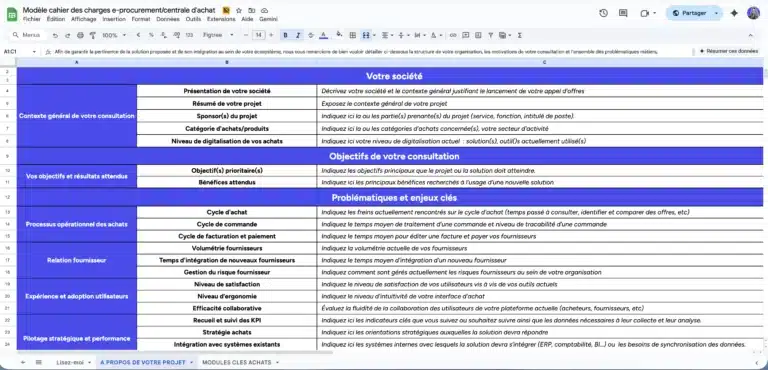
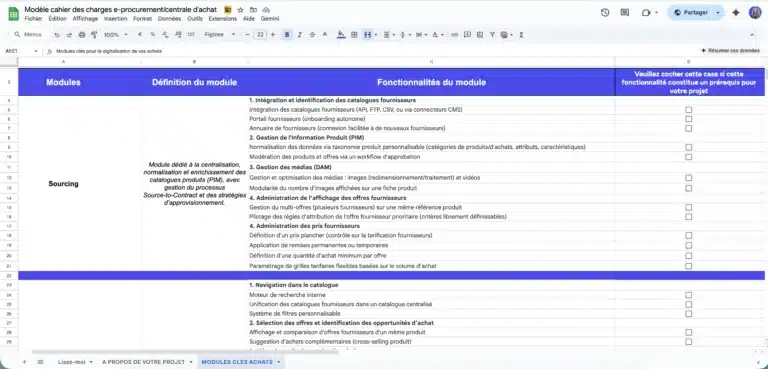
A ready-to-use template to quickly frame your e-procurement or purchasing group project, compare market solutions, and secure your vendor consultation process.
Comprehensive model used in B2C, B2B or C2C projects and ready to adapt.
3. 7 AI use cases for your product listings
| AI Use Case | Principle & Functioning | Value Added & Concrete Example |
|---|---|---|
| ✍️Automated description generation | The AI generates a complete, structured, SEO-optimised description from minimal information (title, key attributes). It adapts tone and detail level to the context (technical for B2B, marketing for B2C). | Example: "Blue nitrile glove, EN 374, 0.12mm thickness, size L" becomes a 150-word text including typical applications, detailed safety standards, material benefits and storage conditions. |
| ⚖️Technical attribute normalisation | The AI normalises heterogeneous data conventions from different sellers to create a homogeneous reference set. | Essential for faceted search and cross-seller comparison. Example: The AI understands that "stainless steel", "inox 304", and "SS304" are the same, or converts grams to kilograms automatically. |
| 🧩Missing field completion | The AI analyses existing data and product context to infer and suggest missing fields to the operator for validation. | Example: If a seller has entered the brand, model and category of a power tool, the AI can infer the voltage, weight or battery type from its knowledge base. |
| 🗂️Automatic categorisation | The AI analyses each product's title, description and attributes to instantly suggest the most relevant category within your taxonomy. | Saves days of manual work and accelerates the onboarding of large sellers (e.g., importing 5,000 references). Deeply integrates with PDM/PIM tools. |
| 🌍Contextualised multilingual translation | Unlike standard sentence-level tools, generative AI translates at the "product level": it understands global technical context. | Adapts technical terminology to the target market and preserves specifications in local formats (units of measurement, standards, sector vocabulary). |
| 🖼️Visual compliance analysis | Computer vision AI analyses product images to verify they meet your standards: white background, minimum resolution, number of angles, no overlaid text, match with description. | Automates quality control. Non-compliant images are automatically flagged to the seller for correction before publishing. |
| 🚨At-risk listing detection | The AI identifies structural anomalies: description too short, missing attributes, price inconsistent with the category, or low-quality images. | Proactive moderation tool: these listings are surfaced in an operator dashboard with action priority, improving overall catalogue quality. |
4. AI and B2B catalogues: the specifics
On a B2B marketplace, product listings have specific requirements that AI can address.
More numerous and more precise technical attributes
A B2B product can have dozens of technical attributes: dimensions, weight, materials, compliance standards, certifications, shelf life, storage conditions. AI helps structure and complete these attributes from supplier data sheets, technical PDF files or even digitised paper catalogues.
Personalised pricing context
In B2B, the same product often has different prices depending on the customer, volume or contract. AI does not intervene on pricing itself, but it can enrich the listing with the information needed for comparison: unit price, packaging, minimum order quantity, lead time. This structured data is essential for RFQ processes and supplier comparison.
Enrichment from external sources
AI can cross-reference seller data with external sources (technical databases, manufacturer data sheets, sector catalogues) to automatically complete missing attributes. This is a considerable time-saver for sellers with large catalogues but sparse data.
5. AI and B2C / C2C catalogues: the specifics
| Model & Specificity | AI Application (Functioning) | Value Added & Impact |
|---|---|---|
| 🛍️B2C: The marketing dimension | The product listing serves a dual function: inform and persuade. AI generates descriptions that combine factual attributes with marketing elements (user benefits, use cases, comparison with alternatives). | The tone adapts automatically to the marketplace's positioning (premium, accessible, technical, lifestyle) to maximise conversion. |
| 🎯B2C: Personalised recommendations | AI analyses purchasing behaviour to personalise the product recommendations displayed on each listing. It dynamically understands each buyer's style, budget and usage preferences. | "Buyers who viewed this product also liked" becomes genuinely relevant. The impact is a measurable increase in average basket size. |
| 🤝C2C: Simplification for private sellers |
Since private sellers often do not know how to write an optimised product listing, AI acts as a complete assistant:
|
Dramatically reduces the barrier to entry for individual sellers and improves overall catalogue quality. See our article on the second-hand market in 2026. |
6. Making your catalogue "AI-ready" for agentic commerce
In 2026, preparing your catalogue for AI agents is no longer a future project. It is a competitiveness workstream.
What AI agents need from your catalogue
An AI agent searching for a product on behalf of a buyer needs:
- Structured, normalised data: attributes in dedicated fields, not buried in free-text descriptions.
- Consistent taxonomy: a logical, complete category tree.
- Real-time availability: stock levels and lead times that are current.
- Machine-readable pricing: unit price, packaging price, discount conditions, all in structured fields.
- Accessible APIs: data must be queryable via API, not only through a graphical interface.
The Catalogue Quality Score
Create an internal metric that measures listing completeness: percentage of mandatory fields filled, image quality, attribute normalisation, update frequency. This indicator becomes a first-class operational KPI. See our marketplace KPIs guide for how to integrate it into your dashboard.
Origami Copilot: AI on the buyer side
Beyond catalogue enrichment, AI also intervenes on the buyer side. Origami Copilot is a conversational AI assistant that allows buyers to search your catalogue in natural language, renew orders in one click and import bulk orders from a file or photo. But for Copilot to perform at its full potential, it needs a structured, complete catalogue. Investing in product data quality directly feeds the AI assistant’s performance.
7. Best practices and limitations
| Key Point | Explanation & Action |
|---|---|
| ✅ Implementation Best Practices | |
| 🏆Focus on Top Products | Start by enriching the 20% of listings that generate 80% of your GMV first. The impact on your sales will be immediate and measurable. |
| 📏Define Quality Standards | Define your quality standards before deploying AI: mandatory fields, image formats, minimum description length, required attributes per category. |
| 🧑💻Human in the Loop | The AI generates, the human validates. This step is crucial, especially for critical attributes (technical specifications, safety standards, regulatory data). |
| 📈Measure the Impact | Compare key KPIs before and after introducing AI: conversion rate, return rate, and seller time spent on catalogue creation. |
| 🎓Train Your Sellers | Explain how to provide the minimal raw data so the AI can do the rest. A seller who understands the process provides better input data. |
| ⚠️ Limitations to Anticipate | |
| 👻Risk of Hallucinations | AI can sometimes invent technical attributes or specifications that do not exist. Human validation remains essential to secure critical data. |
| 🗑️Dependency on Input Data | Input quality determines output quality. If the seller provides incorrect data (wrong reference, photo of the wrong product), the AI will not correct the fundamental error. |
| 💸Cost at Scale | On a large catalogue (e.g., 100,000 listings), AI processing costs can become significant. It is imperative to prioritise based on business impact. |
| ⚖️Intellectual Property | AI-generated descriptions are generally not copyrightable in most jurisdictions. While this usually has no impact for e-commerce product listings, it is a legal point worth knowing. |
Conclusion
Catalogue quality is the foundation of your marketplace’s performance. Whether you want to build a B2B marketplace, a B2C multi-vendor platform or a second-hand marketplace, our experts can help you structure and enrich your catalogue. Discover Origami Copilot, the AI assistant for you.
Let's talk about your project.
Let’s discuss it. our expertise extends beyond the tool as we help you structure your project with the right methodology to guarantee its success.

It can generate a very convincing first draft from raw data, but human validation remains recommended, particularly for critical technical attributes (safety standards, certifications, regulatory data). The optimal approach is: AI generates, human validates and corrects.
The impact is significant. Complete product listings with unique descriptions, structured attributes and relevant keywords are better indexed by Google. Marketplaces that move from a minimal-data catalogue to an AI-enriched one typically see organic traffic growth within weeks.
The cost depends on volume and enrichment complexity. Generative AI models charge by usage (number of tokens processed). For a catalogue of 10,000 listings, processing cost is typically in the range of a few hundred euros, which is far below the cost of manual enrichment.
Yes. Modern LLMs can read PDFs (technical data sheets, supplier catalogues) and extract structured data: technical attributes, dimensions, materials, certifications. This is a particularly useful use case in B2B, where suppliers frequently share data as PDF files.
AI radically simplifies the process: the seller takes a photo, the AI identifies the product, generates a description and suggests a price. The seller simply validates. This is the most powerful lever for increasing the number of published listings and catalogue quality on second-hand marketplaces.
Yes. AI can integrate into your existing catalogue management workflow, whether you use a dedicated PIM or your marketplace solution’s native tools. Enrichment sits upstream or alongside the PIM, completing raw data before publication.