Group purchasing organization (GPO): definition, role, types and examples
- Alexandre Duquenoy
- Estimated reading time: 14 minutes
A group purchasing organization (GPO), also called a buying group or purchasing cooperative, is a structure that pools the purchasing of its members (stores, franchisees, member businesses, public bodies) to get better terms from suppliers. INSEE, France’s national statistics institute, defines it as a structure that manages the purchasing of its affiliates, which can be retailers or wholesalers.
This guide covers the definition, the role, the operating models, the main types of purchasing organizations and their limits, with concrete examples. Most of the examples come from France, where Origami Marketplace was founded.
Table of contents:
- What is a group purchasing organization?
- What does a group purchasing organization do?
- How does a GPO work? The 4 models
- Purchasing organization or negotiating organization: what is the difference?
- The main types of purchasing organizations
- Benefits and limits of a GPO
- Creating or digitizing a GPO
- Frequently asked questions
1. What is a group purchasing organization?
A group purchasing organization pools the needs of several buyers to carry more weight with suppliers. According to INSEE, it handles product research, supplier sourcing and purchase negotiation, and sometimes distribution, organization and documentation. Its services are reserved for its members, who are bound to it by contract.
In the French public sector, the concept has a legal definition. Article L2113-2 of the French Public Procurement Code describes a central purchasing body as a buyer whose purpose is to carry out, on a permanent basis and on behalf of other buyers, at least one of two activities: acquiring supplies or services, or awarding contracts for works, supplies or services.
2. What does a group purchasing organization do?
Its role comes down to four missions:
- Pooling members’ volumes to negotiate prices and terms: volumes, delivery times, payment terms.
- Selecting and approving suppliers, then keeping the negotiated offer up to date.
- Simplifying members’ orders, with a single point of contact when supply goes through the organization.
- Standardizing a network’s offer: the same products and the same standards from one location to the next.
For members, the benefit is buying for less and spending less time searching and negotiating. For suppliers, the organization opens access to every member of a network.
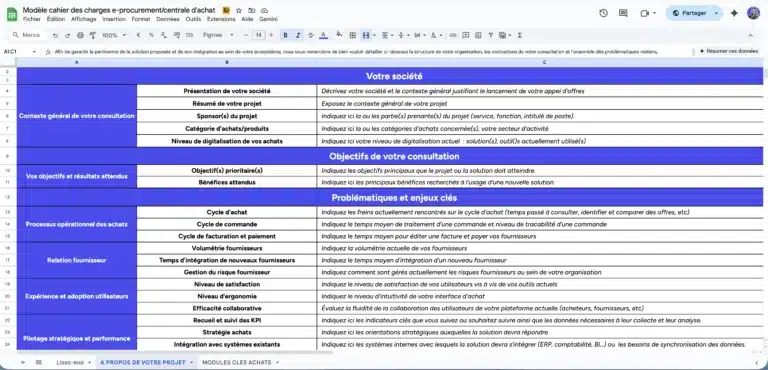
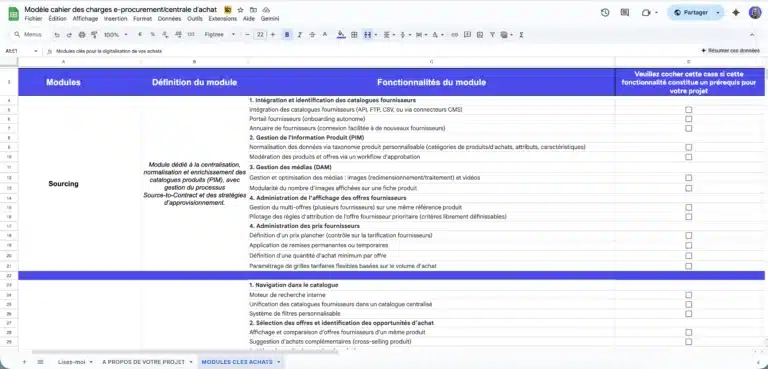
Ensure nothing is overlooked in your project specifications


A ready-to-use template to quickly frame your e-procurement or purchasing group project, compare market solutions, and secure your vendor consultation process.
Comprehensive model used in B2C, B2B or C2C projects and ready to adapt.
3. How does a GPO work? The 4 models
Not all purchasing organizations work the same way. Four models are usually distinguished, depending on who buys and how the organization earns revenue (source: Toute la Franchise, a French franchise publication).
| What the organization does | How it earns revenue | |
|---|---|---|
| Listing | Negotiates preferred rates and lists them in a catalog. Members buy directly from suppliers. | Commission, or member fees |
| Commission agent | Buys on behalf of members, without suppliers knowing who the products are for. | Commission |
| Authorized agent | Pools members’ purchase orders and passes them on to suppliers, after negotiating prices. | Commission |
| Wholesaler | Buys in bulk and resells to members. | Margin |
The model changes members’ day-to-day work. With a wholesaler model, they have a single supplier: the organization. With a listing model, they stay in control of their purchasing, but place orders with each supplier, which adds to their workload.
4. Purchasing organization or negotiating organization: what is the difference?
The two are often confused. The difference lies in buying for resale. A negotiating organization (in French, centrale de référencement) selects suppliers and negotiates commercial terms, but does not buy to resell: as the French business site Journal du Net puts it, buying and reselling is not part of its activity. It is most often funded by member fees.
A purchasing organization in the strict sense carries out transactions on behalf of its members, or even buys and resells at a margin (wholesaler model).
5. The main types of purchasing organizations
Grocery and mass retail
Retail chains negotiate through purchasing alliances, sometimes European ones. Wikipedia cites, for example, Eurelec Trading (E.Leclerc and Rewe) and Everest (Système U, Edeka and Picnic).
Franchise networks, cooperatives and buying groups
A franchisor or network headquarters can create its own purchasing organization for its franchisees or members: an integrated purchasing arm, a cooperative or a buying group. See our guides to the member portal for buying groups, the franchise ordering platform and the marketplace for sports federations.
Public purchasing organizations
In France, public buyers (central government, local authorities, hospitals) can use a central purchasing body, which runs the competitive tendering for them. Nationally, examples include UGAP, UNIHA and RESAH. There are also regional and local bodies, often attached to a region or a metropolitan area. In the United States, the closest counterpart is usually called cooperative purchasing.
Purchasing organizations for businesses
Some negotiating organizations serve businesses, including small and mid-sized companies, for their indirect spend. Journal du Net cites, for example, logistics, IT, facility services, healthcare products and office supplies.
6. Benefits and limits of a GPO
Benefits
- Lower purchase prices thanks to volume, which cut costs or allow more attractive selling prices.
- A consistent offer across the whole network.
- A single point of contact for orders, when supply goes through the organization.
- Less time spent searching for and negotiating with each supplier.
Limits
- Price transparency. When members must buy through the organization, a member can pay more than when buying directly if prices are not transparent. Toute la Franchise reports that several French franchisors have been convicted for this reason.
- The management workload. With a listing model, each member orders from each supplier: carts, invoices and follow-ups multiply.
- The balance of power with suppliers. In retail, purchasing alliances are criticized for the weight they give retailers over suppliers, most of them small and mid-sized businesses (Wikipedia).
7. Creating or digitizing a GPO
Creating a group purchasing organization means choosing a model (listing or buying for resale), a legal structure and a tool to process orders. Our guides cover each step: how to create a group purchasing organization and how to digitize a group purchasing organization.
A marketplace-style platform combines both approaches: the organization approves suppliers and sets the terms, then each member orders online from several suppliers, at the prices negotiated for them. That is the principle of the Origami Marketplace group purchasing platform.
Two networks already equipped:
- Orpi, France’s largest real estate network by number of branches: its purchasing platform connects 1,350 branches and 52 suppliers (see the case study).
- French Tennis Federation: its paper catalog became Proshop FFT, a B2B marketplace for more than 7,000 affiliated clubs, with 10,000 items compared with 2,000 at launch (see the case study).
More than 97 companies have launched their platform with Origami, up and running in under 4 months.
8. Frequently asked questions
What is the role of a group purchasing organization?
Pooling its members’ purchasing to negotiate better terms (prices, volumes, delivery times, payment terms), selecting and approving suppliers, and simplifying members’ orders.
What are the different types of purchasing organizations?
By operating model: listing, commission agent, authorized agent or wholesaler. By sector: retail purchasing alliances, purchasing organizations for franchise networks and cooperatives, public purchasing bodies (UGAP, UNIHA, RESAH in France) and negotiating organizations for businesses.
What is a public purchasing organization?
In France, a public buyer whose permanent mission is to buy supplies or services, or to award contracts, on behalf of other public buyers (Article L2113-2 of the French Public Procurement Code). UGAP is a national example. In the United States, this is usually called cooperative purchasing.
What are the main retail purchasing alliances?
Wikipedia cites Eurelec Trading (E.Leclerc and Rewe) and Everest (Système U, Edeka and Picnic). These alliances between retailers change regularly.
How does a group purchasing organization earn revenue?
Through commissions, through a margin when it buys and resells (wholesaler model), or through member fees, a common model for negotiating organizations.
What is the difference between a GPO and a marketplace?
A GPO is an organization that negotiates, and sometimes buys, for its members. A marketplace is a tool: a platform where several suppliers sell. A GPO can use one so that its members order online from approved suppliers, at the negotiated terms.
Let's talk about your project.
Let’s discuss it. Our expertise extends beyond the tool as we help you structure your project with the right methodology to guarantee its success.