HomeBlogB2B e-procurement platformMarketplace SEO: 10 Levers to Rank Your Category Pages
Marketplace SEO: 10 Levers to Rank Your Category Pages
43% of all e-commerce traffic comes from organic search and 23.6% of online orders are […]
Marketplace SEO: 10 Levers to Rank Your Category Pages
- Julien Bruitte
- Estimated reading time: 15 minutes

43% of all e-commerce traffic comes from organic search and 23.6% of online orders are directly attributable to SEO. For a multi-vendor marketplace, where the catalogue can contain tens of thousands of product listings fed by hundreds of sellers, organic search is not a “nice to have”. It is a structural acquisition channel.
The challenge is that marketplace SEO has nothing in common with SEO for a brochure site or even a single-vendor e-commerce store. Faceted navigation generates millions of phantom URLs that drain Google’s crawl budget. Product listings created by sellers are often thin on content. Category pages cannibalise each other. And duplicate content between sellers offering the same references runs rampant.
This guide covers the 10 operational levers to regain control of your marketplace SEO, with a focus on the two page types that generate the most organic traffic: category pages and product listings.
Table of contents:
- Tame faceted navigation (trap #1)
- Build a category architecture aligned with search intent
- Enrich category pages with editorial content
- Enforce quality standards on seller product listings
- Implement Product and FAQ schema markup
- Structure internal linking
- Optimise crawl budget
- Work on Core Web Vitals
- Use AI to scale catalogue enrichment
- Build authority through content marketing and link building
1. Tame faceted navigation (trap #1)
This is the single most critical technical issue for any marketplace. And the one most operators discover too late.
The problem: your marketplace offers filters (brand, size, colour, price, availability). Each filter combination generates a unique URL. A catalogue with 15 filterable attributes and 8 options each can theoretically produce billions of URL combinations. Googlebot discovers them, crawls them, and burns your crawl budget on pages nobody searches for. A 2026 SEO Engico audit across five e-commerce sites found that 4 out of 5 had over 60% of their Googlebot crawl consumed by faceted URLs, leaving commercially valuable product pages recrawled only once every 90 to 120 days.
What to do: classify every facet into one of 4 categories (there is no fifth option):
| Facet type | Technical SEO action | Example and use case |
|---|---|---|
| ✅Indexable | Create a dedicated category page with unique editorial content. | Matches a real search intent (e.g. "men's Nike running shoes"). |
| 🔗Canonicalisable | Add a rel=canonical tag pointing to the parent category. | Filter variations with near-identical content and no unique indexation value. |
| 🛑Blockable | Block via robots.txt or use a meta noindex tag. | Parameters with no SEO value that waste crawl budget (e.g. sort by price, /page/47/). |
| 💻Client-side (AJAX) | Execute the filter client-side (JavaScript) without generating a crawlable URL. | The cleanest method for secondary filters that generate millions of combinations. |
Emergency check: go to Google Search Console > Crawl Stats. Count what percentage of Googlebot requests land on parameter URLs (?sort=, ?color=, ?price=, /page/47/). Above 30%, you have a crawl budget problem.
2. Build a category architecture aligned with search intent
Category pages = SEO landing pages
On a marketplace, category pages are your primary SEO landing pages. That is where search volume concentrates: “office supplies”, “industrial PPE”, “power tools”. Your product listings capture the long tail; your category pages capture the baseline traffic.
Mirror your taxonomy to search queries
Your product taxonomy should reflect how your buyers search, not how your sellers organise their catalogue. Use Google Search Console, SEMrush or Ahrefs to map queries by volume and intent, then structure your hierarchy accordingly.
Concrete example: if your buyers search for “chemical-resistant gloves” (strong intent) but your taxonomy offers “PPE > Gloves > Multi-purpose”, you lose the SEO match. Create a “Chemical-Resistant Gloves” subcategory with a dedicated URL, an optimised H1 and specific content.
The 3-click rule
Every product in your catalogue should be reachable within 3 clicks from the homepage. Beyond that, crawl depth penalises indexation and PageRank distribution.
Ensure nothing is overlooked in your project specifications
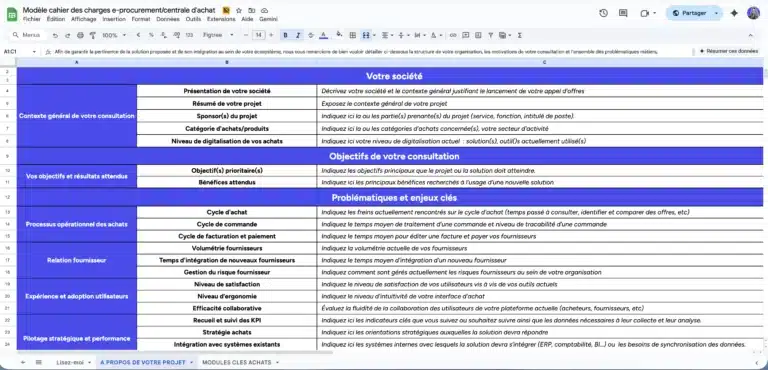
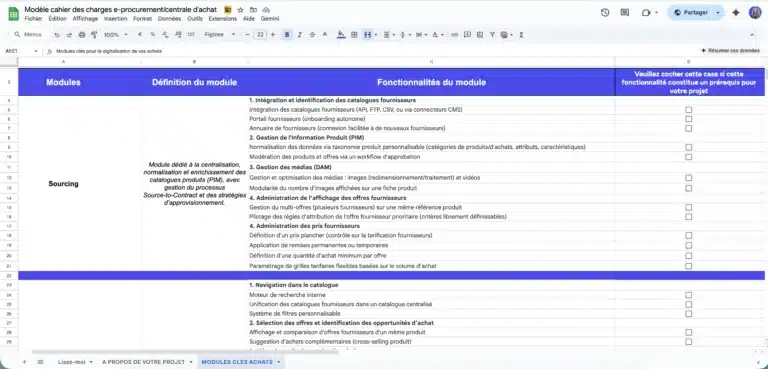
A ready-to-use template to quickly frame your e-procurement or purchasing group project, compare market solutions, and secure your vendor consultation process.
Comprehensive model used in B2C, B2B or C2C projects and ready to adapt.
3. Enrich category pages with editorial content
A category page that contains nothing but a product grid with filters does not rank. Google needs textual content to understand the page’s theme and differentiate it from competitors.
What works:
- An introductory paragraph (150-300 words) above or below the product grid, describing the category, its use cases and selection criteria.
- A FAQ block at the bottom of the page, with frequent buyer questions about that category (marked up with FAQ schema).
- Contextual links to subcategories, related buying guides and relevant blog articles.
What does not work: generic keyword-stuffed text, hidden from the user (collapsed in an accordion), copy-pasted from one category to another.
4. Enforce quality standards on seller product listings
The marketplace-specific challenge
On a standard e-commerce store, you control 100% of your product content. On a marketplace, your sellers create the listings. Quality varies wildly: one seller provides 3 lines and a blurry photo, another provides a complete listing with technical attributes, HD visuals and marketing copy.
Google makes no distinction. If 60% of your listings are thin, the overall quality signal of your domain suffers.
The standards to enforce
- Normalised title: [Brand] + [Product name] + [Differentiating attribute] + [Reference]. No all-caps titles, no 3-word titles.
- Unique description of at least 150 words, structured with use case, features and benefits.
- Technical attributes in dedicated fields (not buried in the description).
- Images: 3 minimum, 800x800px minimum, white background or contextualised.
For the full methodology, see our guide on how to create a product data sheet for your marketplace.
Automate moderation
Configure automatic validation rules in your back-office: a listing that does not meet minimum criteria is not published. This is a quality gate that protects your SEO as much as your buyer experience.
5. Implement Product and FAQ schema markup
Schema markup (structured data) enables Google to understand your page content precisely and display rich results (rich snippets): price, availability, reviews, star ratings. In 2026, with the rise of Google’s AI Overviews, structured data also directly feeds the AI-generated answers that appear above organic results.
Schemas to implement:
| Schema type | Placement | SEO objective and SERP display |
|---|---|---|
| 📦Product | On every product listing | Provides Google with name, price, availability, brand and SKU to generate Rich Snippets. |
| ⭐AggregateRating | On every product listing | Displays star ratings and review count directly in search results. |
| ❓FAQ | Category pages and guides | Designed to capture Featured Snippets (position 0) and "People Also Ask" boxes. |
| 📍BreadcrumbList | Across all pages | Helps Google understand your hierarchy and displays a clean breadcrumb instead of the raw URL. |
| 🏢Organization | Homepage | Strengthens authority and trust signals (E-E-A-T) for the marketplace. |
6. Structure internal linking
Internal linking distributes PageRank
On a marketplace with thousands of pages, internal linking determines which pages receive authority and which stay invisible. A poorly structured link architecture concentrates PageRank on the homepage and top-level pages, leaving product listings orphaned.
Best practices
- Clickable breadcrumb on every page, reflecting the category hierarchy.
- Links between sibling subcategories (“You may also be looking for: Nitrile gloves | Latex gloves | Leather gloves”).
- Links from product listings to the parent category and to complementary products.
- Links from blog articles to target category pages and product listings. That is the role of content marketing (lever #10).
What to avoid
Mega-menus with hundreds of links on every page. They dilute PageRank and complicate crawling. A hierarchical navigation with a reasonable link count per page performs better.
7. Optimise crawl budget
Why it matters more on a marketplace
Google allocates a crawl budget to every site. On a 500-page site, it is a non-issue. On a marketplace with 100,000 product listings, 50 category pages and potentially millions of faceted URLs, crawl budget becomes a bottleneck.
Concrete actions
- Clean XML sitemap: include only indexable, canonical URLs. No redirects, no noindexed pages, no parameter URLs.
- Robots.txt: block URL patterns with no SEO value (sort parameters, deep pagination, empty result pages).
- Server response time: Google crawls faster when sites respond faster. A TTFB (Time to First Byte) under 200ms is the target.
- HTTP status codes: eliminate redirect chains (301 > 301 > 301), soft 404s and pages returning a 200 with empty content.
See our article on Marketplace and API for how an API-first architecture simplifies technical SEO management.
8. Work on Core Web Vitals
The ranking impact
Core Web Vitals (LCP, INP, CLS) are confirmed ranking signals by Google. On a marketplace, they pose specific challenges: category pages load dozens of product images, faceted navigation triggers JavaScript re-rendering, and third-party scripts (analytics, chat, payment) slow down load times.
Priority levers
| Metric (Signal) | Target | Priority optimisation action |
|---|---|---|
| ⏱️LCP (Largest Contentful Paint) |
Under 2.5 seconds | Optimise product image loading: lazy loading, next-gen formats (WebP/AVIF), CDN distribution. |
| ⚡INP (Interaction to Next Paint) |
Excellent responsiveness | Handle filter application via client-side AJAX to avoid full page reloads on category pages. |
| 📐CLS (Cumulative Layout Shift) |
Total visual stability | Reserve fixed dimensions for images and ad blocks before they load to prevent layout shifts during scrolling. |
In Q4 2025, smartphones accounted for 71% of online purchases (Statista). Your Core Web Vitals must be optimised for mobile first.
9. Use AI to scale catalogue enrichment
On a marketplace, your product listing SEO depends on your sellers. Most of them are not SEO copywriters. The result: truncated titles, 2-line descriptions, missing attributes. Multiplied by thousands of listings, this is a massive content deficit.
AI as an accelerator
Generative AI enables you to:
- Generate structured descriptions from the raw attributes provided by the seller.
- Normalise technical attributes (units, formats, terminology).
- Automatically categorise products into your taxonomy.
- Detect at-risk listings (content too short, non-compliant images, inconsistent pricing).
Our article on AI and marketplace product listings covers the full range of use cases. And on the buyer side, Origami Copilot transforms product search into a conversation, reducing dependence on your internal search engine and improving conversion. But for AI to perform, it needs structured catalogue data, which circles back to lever #4.
10. Build authority through content marketing and link building
The blog as an SEO lever
A marketplace blog serves two SEO functions: capturing informational traffic (buying guides, comparisons, tutorials) and distributing PageRank to category pages and product listings through internal linking.
Example: an article “How to choose chemical-resistant gloves in 2026” captures long-tail traffic and links to your “Chemical-Resistant Gloves” category page and to recommended product listings. That is a PageRank transfer mechanism.
Link building
Backlinks remain a major ranking factor. For a marketplace, the strategies that work:
- Digital PR: publish market studies, industry barometers, exclusive data. Trade media pick them up and link to you.
- Seller partnerships: ask your sellers to link their marketplace seller page from their own website. It is a natural, relevant link.
- Guest blogging: contribute expert articles to trade publications that link back to your marketplace.
Link building towards category pages (not just the homepage) is the most underexploited lever in marketplace SEO.
Conclusion
SEO is a durable acquisition channel for your marketplace. Whether you are building a B2B marketplace, a B2C multi-vendor platform or a second-hand marketplace, our experts can support you on technical architecture, catalogue quality and SEO optimisation.
Let's talk about your project.
Let’s discuss it. our expertise extends beyond the tool as we help you structure your project with the right methodology to guarantee its success.

FAQ
Taming faceted navigation. It delivers the most impact per pound invested because it unlocks crawl budget for every other page. A site where 60% of crawl is wasted on faceted URLs will not progress, regardless of investment in content or link building.
Technical SEO (facets, crawl budget, schema markup) produces results within 4 to 8 weeks of implementation. Product listing enrichment and editorial content take 3 to 6 months to translate into significant organic traffic. Link building is a continuous effort whose effects compound over 6 to 12 months.
Both. Category pages capture head-term traffic (generic, high-volume queries), product listings capture the long tail (specific, high-purchase-intent queries). Organic e-commerce traffic converts at an average of 2.8% (Smart Insights, 2025), which outperforms most paid channels. Sacrifice neither.
This is a classic marketplace scenario. If several sellers offer the same product, create a single canonical product page that aggregates all seller offers, with a built-in comparator (price, lead time, seller rating). This is the Amazon model. Each individual seller offer does not need its own indexable URL.
Yes, in three significant ways. First, faceted navigation is more complex (more filters, more combinations). Second, product content quality is heterogeneous (you do not control what your sellers publish). Third, duplicate content management is more frequent (same product offered by multiple sellers). The SEO fundamentals remain the same, but execution demands greater technical rigour.