C-Class Purchasing: Definition, TCO and Optimization
Alexandre Duquenoy
Estimated reading time: 14 minutes
Long seen as a cloud of minor, scattered expenses, C-class purchases are now one of the largest productivity reserves for procurement and finance teams. Behind their low unit value lies a complex reality: massive transaction volumes, a highly fragmented supplier base and disproportionate administrative costs.
In 2026, operational excellence is no longer won only in strategic A-class negotiations, but in systematic control of transactional flows.
C-class purchases cover all goods and services characterized by:
A low unit value (micro-spend).
A high transaction volume (high frequency).
An often non-recurring or unpredictable nature.
Geographic dispersion and requesters who are not buyers.
The C-class paradox: this category usually represents a major imbalance in the organization:
About 5% of total purchasing spend.
50 to 75% of order volume.
Up to 85% of active items in the database.
2. The Pareto principle and ABC analysis
Purchasing segmentation builds on the work of economist Vilfredo Pareto and the Pareto principle (the 80/20 rule). This analysis tool ranks optimization efforts by financial impact and operational complexity.
Class
Share of spend
Transaction volume
Strategic nature
Class A
~80%
~20%
Critical, vital, relationship-driven purchases.
Class B
~15%
~30%
Intermediate, recurring purchases.
Class C
~5%
50-75%
Transactional purchases, the "long tail".
Strategic note: optimizing C-class processes is often more profitable than simply negotiating the face price, because it tackles organizational friction.
3. Indirect spend vs C-class purchases
It is important not to confuse the accounting nature of a purchase with its transactional nature:
Indirect spend: expenses needed to run the business (energy, marketing, HR). A $1M energy contract is indirect spend, but it belongs to Class A.
C-class purchases: defined by their transactional nature. They include supplies, PPE, small tools, emergency maintenance services (MRO) and promotional items.
Turn your long tail into a performance lever
Our guide to tail spend and maverick spend explains how to measure off-contract purchases, what they really cost and the six levers to reduce them.
TCO (total cost of ownership) is the central metric. The purchase price is only the tip of the iceberg.
The flood of indirect costs:
Maverick sourcing (maverick spend): time lost by operational staff searching for a product.
Administrative complexity: creating and maintaining thousands of supplier records.
Financial burden: receiving, matching and paying a massive volume of low-value invoices.
The key figure: the cost of processing an order can range from €70 to €150. For a product bought at €15, the process often costs 10 times more than the product itself.
5. Financial impact and concrete gains
Optimizing C-class purchases is not a nice-to-have, it is a direct financial lever:
Indirect savings: cutting the number of C-class suppliers by 30% can generate up to 10 to 15% indirect savings on administrative costs alone.
Time freed up: automating these flows can redeploy up to 20% of buyers’ time to high value-added categories.
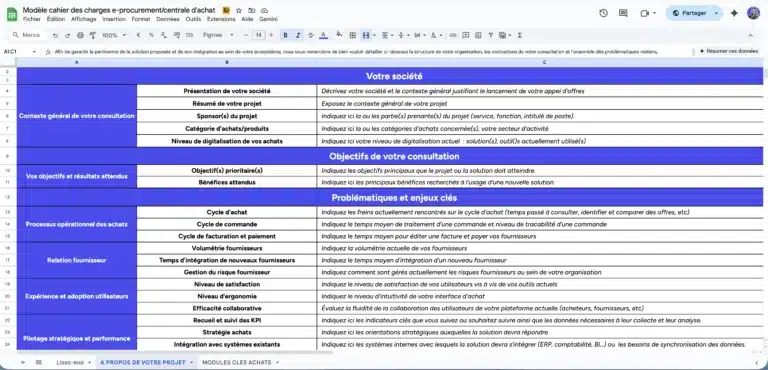
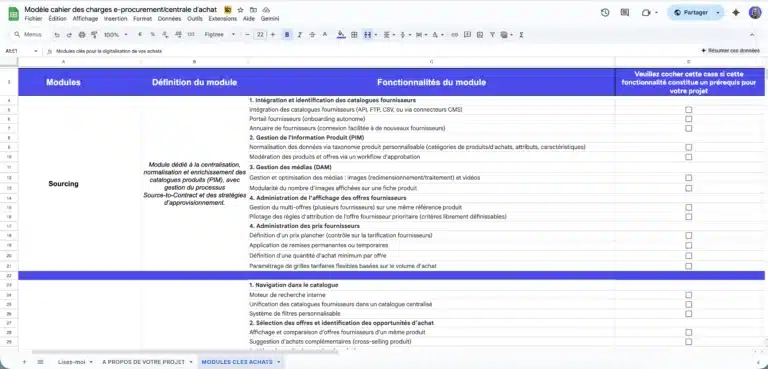
Ensure nothing is overlooked in your project specifications
A ready-to-use template to quickly frame your e-procurement or purchasing group project, compare market solutions and secure your vendor consultation process.
Comprehensive template • Used on B2B purchasing projects • Ready to adapt
6. AI in 2026: from day-to-day control to the C-level view
Artificial intelligence turns long-tail management into a strategic asset for decision-makers:
Predicting recurring needs: anticipating demand peaks on consumables to avoid critical stockouts.
Automatic supplier scoring: real-time evaluation of performance and compliance (ESG, lead times) across thousands of suppliers.
Supplier panel optimization suggestions: AI dynamically identifies opportunities to consolidate volumes into framework agreements.
Budget drift analysis: instant detection of price anomalies or off-process buying behavior.
7. Key KPIs and optimization strategies
Maturity indicators:
Procure-to-pay (P2P) automation rate.
Number of active suppliers relative to spend volume.
Compliance rate (maverick spend).
The strategic action plan:
Rationalization: consolidate the supplier panel to simplify accounting.
Digitization: deploy an internal marketplace or an e-procurement tool.
TCO approach: shift the focus from unit price to overall lifecycle efficiency.
A lasting competitive advantage
C-class purchases are no longer an administrative fate. By building on Vilfredo Pareto‘s core principles and the power of predictive AI, companies turn a historically neglected area into a major competitive advantage. Mastering C-class spend means healthier margins and guaranteed operational continuity.
A purchase with a low unit value but high volume, representing about 5% of spend but up to 75% of transactions.
Why are they strategic?
Because of their TCO. The administrative cost of handling them often exceeds the price of the product. In addition, a stockout on a C-class item (for example, a maintenance part) can bring a production line to a halt.
How do you optimize C-class purchases?
Through digitization, rationalization of the supplier panel and automation with AI to reduce transaction costs.