How custom marketplace development is priced
- Alexandre Duquenoy
- Estimated reading time: 14 minutes
Short answer: a marketplace project is paid for in three places: native features are covered by the license, configuration is part of setup (quoted per project), and custom work (what has to be developed) is quoted separately. At Origami Marketplace, custom work is quoted in days at a daily rate. Before discussing the pricing model, the best lever is to reduce the amount of custom work by checking, line by line, whether a native feature or configuration already covers the need.
1. Fixed fee, daily rate, phases: what are the differences?
| Principle | Benefit | Risk | |
|---|---|---|---|
| Fixed fee | A fixed price for a fixed scope | Budget known in advance | A safety margin is built in; every scope change becomes a change order |
| Days at a daily rate | An estimate in days, billed on time spent or on the estimate | Transparent, suited to needs that evolve | A less fixed budget: require a line-by-line estimate |
| Phased delivery | Custom work is delivered in stages, each phase quoted separately | The first phase works as a test, and you decide on the next one based on results | Requires rigorous project management |
| Handover to your developers | Your team builds around the platform, through the API | No dependence on the vendor for changes | You need a technical team and clear rules on what can be changed |
2. How does pricing work at Origami Marketplace?
- Custom work is quoted in days at a daily rate.
- Native features are included in the license, which starts at $24,000 per year; it is not capped and scales with sales volume.
- Configuration is part of setup, which is quoted separately and depends on the project.
- The open API lets you adapt the platform to your processes: see open API.
The full cost breakdown is in our guide to the cost of a B2B marketplace.
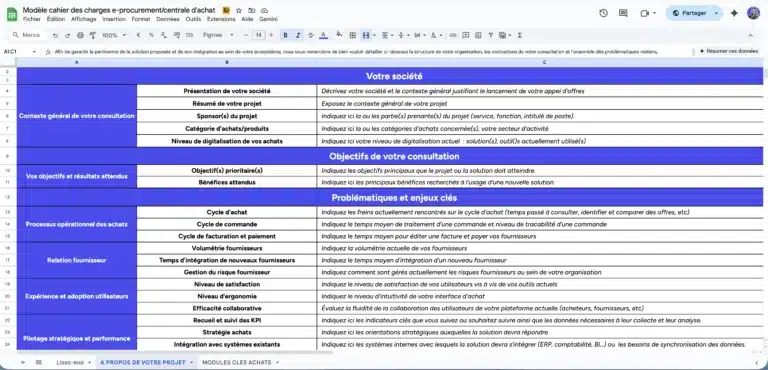
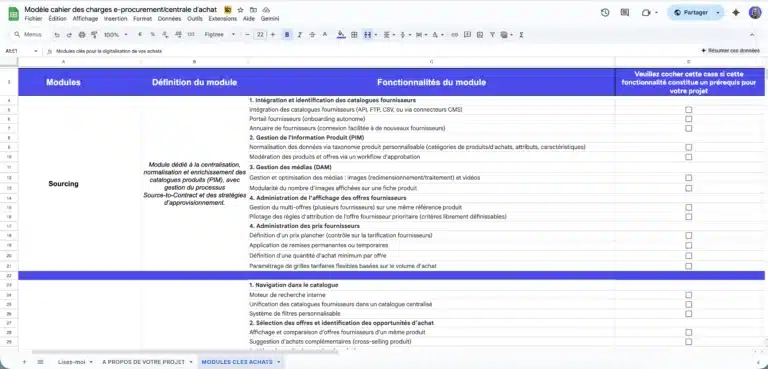
Ensure nothing is overlooked in your project specifications


A ready-to-use template to quickly frame your e-procurement or purchasing group project, compare market solutions, and secure your vendor consultation process.
Comprehensive model used in B2C, B2B or C2C projects and ready to adapt.
3. How do you reduce custom work before signing?
- Write each need as a business need, not as a feature.
- Ask each vendor to classify every line as native, configuration or custom, in a shared table.
- For each line classified as custom, ask whether a native feature or configuration already covers the need.
- Require an estimate in days for every remaining line.
To structure your requirements, see our marketplace specifications template.
4. Questions to ask about custom work
- Is custom work maintained when the platform is updated, and at what cost?
- Who owns the code developed for you?
- How does acceptance testing work, and what does the warranty cover?
5. Frequently asked questions
What is a marketplace vendor's daily rate?
It varies by vendor and by profile. Ask for it explicitly and compare estimates in days against the same table of needs.
Is configuration billed separately?
At Origami Marketplace, configuration is part of setup, which is quoted separately and depends on the project. Custom work is quoted in days at a daily rate.
Can you avoid custom work entirely?
Often for the most part, if needs are written as business needs and the vendor shows the native feature that meets them.
Let's talk about your project.
Let’s discuss it. Our expertise extends beyond the tool as we help you structure your project with the right methodology to guarantee its success.