Member portal: digitizing orders for a buying group or cooperative
Alexandre Duquenoy
Mis à jour le 19/11/2026
4 minutes de lecture
A buying group, a purchasing cooperative or a group purchasing organization (GPO) negotiates terms with suppliers on behalf of its members. The member portal is where those terms turn into orders. Too often, it is little more than a document library: members download catalogs and price lists, then order somewhere else, by email or directly from the supplier.
This guide is for the leaders of buying groups and cooperatives who want a portal where members actually order, from every approved supplier, at the right terms.
For members: find products and negotiated prices, order easily, and track orders, deliveries and invoices without calling the buying group.
For the buying group: enforce agreements, consolidate volumes, prepare negotiations, and potentially generate revenue (commissions, listing fees, supplier subscriptions).
For suppliers: reach the whole network, manage their catalog on their own, and get paid without chasing invoices.
2. Document library or ordering platform
The difference comes down to one question: does the order go through the portal? If it does, the buying group has its own numbers.
Document library
Ordering platform
Catalogs
PDF files or spreadsheets to download
Online multi-supplier catalog, kept up to date by suppliers
Prices
Price lists to look up
Negotiated prices applied automatically at checkout
Ordering
By email, by phone or with the supplier
Multi-supplier cart on the portal
Volumes
Reported by suppliers
Consolidated in real time by supplier and by member
Year-end rebates
Calculated from supplier reports
Calculated from platform data
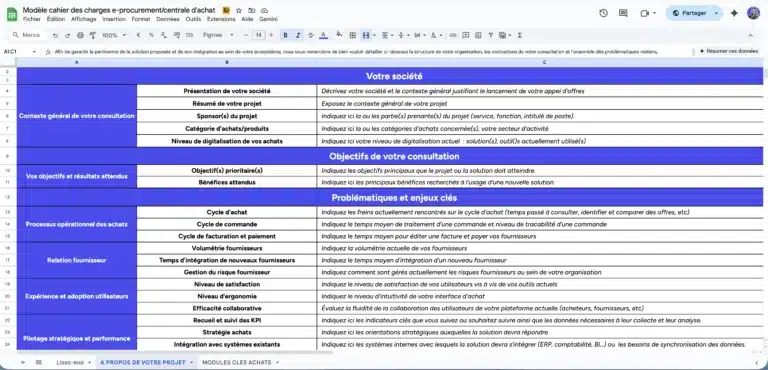
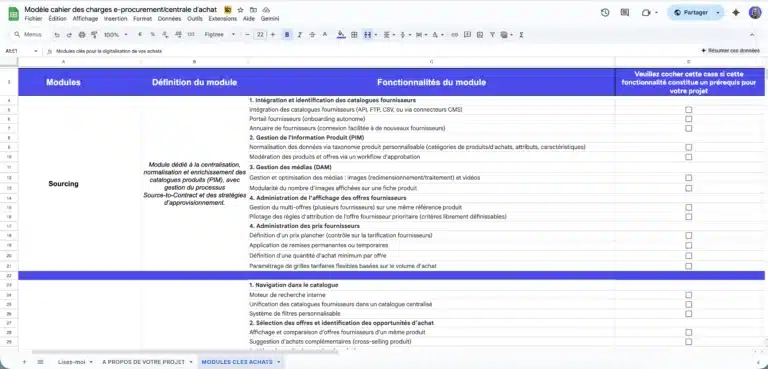
Ensure nothing is overlooked in your project specifications
A ready-to-use template to quickly frame your e-procurement or purchasing group project, compare market solutions, and secure your vendor consultation process.
Comprehensive model used in B2C, B2B or C2C projects and ready to adapt.
3. Key features
Negotiated terms per member: catalog, prices and offers based on each member’s profile, group, volume or contracts, with built-in quotes.
Multi-entity accounts: a member with several locations, differentiated prices, and approval workflows specific to each organization.
Self-service supplier portal: sign-up, document upload, and catalogs and price lists managed by the supplier, with built-in KYC and digital contracts.
Data for volume rebates: volumes consolidated by supplier in real time, with an exportable breakdown by member and by category for your calculations.
Supplier payments and invoicing: payments triggered automatically, with invoices, purchase orders and credit notes generated.
Connection to your tools: if you already use a procurement suite (SAP Ariba, Coupa, Ivalua…), Origami Marketplace connects to it through an API.
4. Getting members and suppliers to adopt the portal
Members: a simple login, ideally with the credentials they already use (SSO), a shopping experience close to consumer websites, and negotiated prices shown without asking for a quote.
Suppliers: a self-service space to manage catalog, inventory and orders, and automatic payments.
Support matters as much as the tool. At Orpi, 52 suppliers were onboarded in under 3 months. The French Tennis Federation supported its suppliers and its volunteer-run clubs over time: the number of active suppliers has grown 50% since launch.
5. Measuring results
Share of members’ purchasing that goes through the portal.
Active members and order frequency.
Active suppliers and number of items: on Proshop FFT, the catalog grew from 2,000 to 10,000 items.
Sales volume and its growth: up 32% from 2023 to 2024 on Proshop FFT.
Gaps between volumes reported by suppliers and volumes recorded on the platform.
6. Buying group, cooperative or GPO: the portal adapts
The portal works whatever the legal structure of the group, whether a buying group, a purchasing cooperative or a group purchasing organization.
The online space where members of a buying group, cooperative or GPO access negotiated offers. In its most useful form, they order there directly from approved suppliers.
How is it different from a member intranet?
The intranet provides documents (catalogs, price lists). The ordering platform lets members order, applies negotiated prices, and consolidates volumes by supplier and by member.
Can we calculate volume rebates from the portal?
Yes. Volumes are consolidated by supplier in real time, with an exportable breakdown by member and by category for your calculations.
Do we have to replace our existing procurement suite?
No. Origami Marketplace can connect through an API to an existing suite (SAP Ariba, Coupa, Ivalua…): you keep your sourcing processes and add the ordering layer.
How long does it take to launch the portal?
With Origami Marketplace, a marketplace is up and running in under 4 months.
Let's talk about your project.
Let’s discuss it. Our expertise extends beyond the tool as we help you structure your project with the right methodology to guarantee its success.