HomeBlogNon classéHow to write a Marketplace Requirements Document
How to write a Marketplace Requirements Document
A marketplace requirements document tells your developer, or your SaaS provider, exactly what you’re trying […]
How to write a Marketplace Requirements Document
- Arnaud
- 6 minutes to read
A marketplace requirements document tells your developer, or your SaaS provider, exactly what you’re trying to build before a single line of code gets written or a single module gets configured. Skip it, or write it poorly, and you end up paying for guesswork: features nobody asked for, missing ones nobody flagged, and a quote that keeps shifting as the real scope surfaces mid-project.
This guide covers what such a document needs to contain, in what order, and which mistakes tend to inflate budgets the most.
Start with the business case, not the feature list
Before listing what the platform should do, explain why it exists. What problem does it solve, and for whom? Who are the buyers, the sellers, and the administrators who will use it day to day? How does the business make money: a commission on transactions, a subscription fee, or a mix of both?
These questions might feel like a detour from the “real” specification, but they aren’t. A developer or a SaaS provider who understands your business model will flag inconsistencies you’d otherwise only discover after launch, like a commission structure that doesn’t match your payment provider’s payout rules.
Map the three journeys every marketplace shares
Whatever you’re selling, a marketplace tends to boil down to three journeys: how someone joins and sets up their profile, how buyers and sellers find each other, and how a transaction actually happens.
Take a marketplace for refurbished office furniture as an example. A seller’s onboarding journey covers signing up, verifying their identity, and listing their first item with photos and a condition rating. The discovery journey covers how a buyer searches, filters by category or location, and compares listings. The transaction journey covers the offer, the payment, and what happens if the item doesn’t match its description.
Each step in these journeys generates a requirement. If buyers should be able to filter by delivery radius, that data has to be collected somewhere during onboarding. If disputes need a resolution window, that rule has to live in the transaction flow, not get bolted on later.
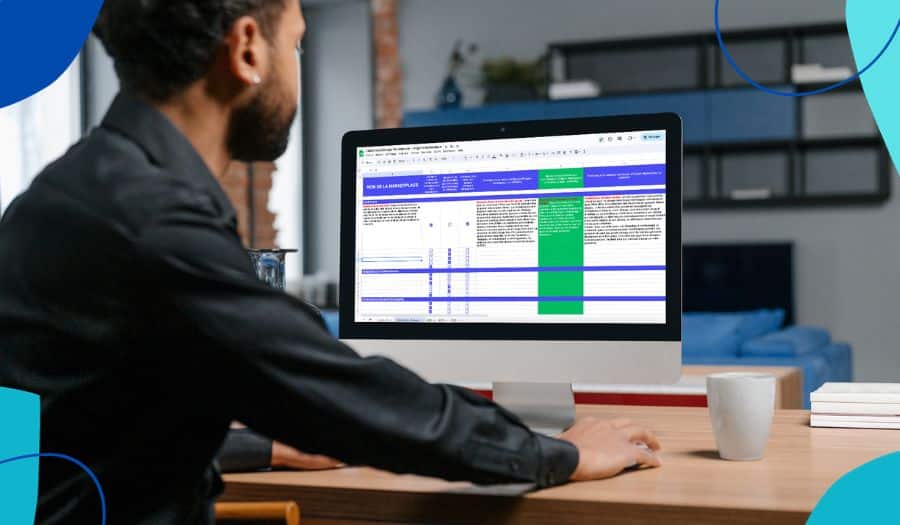
Ready to write your marketplace requirements document?
Download our template below:
Break requirements down by module, not by wish list
Once the journeys are mapped, group the resulting requirements by module rather than as one long list. A workable breakdown usually includes: catalog and listings, search and filters, cart and checkout, payments and seller payouts, the seller dashboard, the admin back office, notifications, and reviews or dispute handling.
For each module, note which parts are needed for launch and which can wait. A referral program or advanced analytics dashboard rarely belongs in an MVP, even if it sounds appealing in a planning meeting.
Don't leave out the non-functional requirements
Functional requirements describe what the platform does. Non-functional requirements describe how well it needs to do it, and they’re the ones most often left out of a first draft.
At minimum, cover expected performance under concurrent use, security and data protection standards, how payment data is handled (most marketplaces route this through a licensed payment provider rather than storing card data themselves), mobile compatibility, and any regulatory obligations tied to your market. In the EU, for instance, marketplace operators have reporting obligations toward tax authorities under the DAC7 directive, on top of standard GDPR requirements.
Decide early: custom development or a SaaS marketplace platform
This choice changes what the document should even look like. For a fully custom build, the document needs to describe every screen and interaction in detail, since nothing exists yet. For a SaaS marketplace platform, the more useful approach is to map your requirements against what the platform already offers, and flag the gaps that need custom configuration or development.
It’s worth documenting two things regardless of which path you pick: how easily you could migrate your data if you changed providers later, and the total cost over several years, not just the cost to launch. Skipping this comparison is how businesses end up locked into a platform that no longer fits.
Watch out for AI-generated wish lists
It’s increasingly common to see requirements documents that were drafted entirely by AI from a single prompt. They tend to look impressive: thirty or forty pages, dozens of features, confident language throughout. They also tend to share the same problem: broad statements like “the platform should be fast and secure” with no real user flow behind them, and a feature list sized for a mature marketplace rather than a first release.
AI can help you organize and phrase your requirements once you know what they are. It’s a poor substitute for deciding what they should be. Start from your own MVP flows, the ones described above, and use AI to help structure and clarify them rather than to generate them from scratch.
What a usable requirements document actually looks like
In practice, a document that a developer or a SaaS provider can actually work from tends to stay short and cover:
| Section | What it should answer |
|---|---|
| Project summary | What are we building, for whom, and on what timeline? |
| Roles and user journeys | Who are the buyers, sellers, and admins, and what do they each do on the platform? |
| Functional requirements by module | What does each module need to do, split between launch and later? |
| Non-functional requirements | How fast, how secure, how compliant does it need to be? |
| Payments and compliance | Which payment provider, how are funds held and released, which regulations apply? |
| Budget and timeline | What's the target budget range and launch date? |
If you’d rather not build every one of these sections from a blank page, a SaaS marketplace platform like Origami Marketplace already covers most of the functional and non-functional groundwork above, which lets your own requirements document focus on what actually needs configuring or customizing for your project.
Want to build an agile, future-proof platform?
Let’s talk. Our expertise goes beyond the tool, as we help you structure your project with the right methodology to ensure its success.