Unified Inventory: The Key to Digitizing Your Retail Network
- Arnaud
- 6 minutes read
What if your 60 stores could become your biggest warehouse? Customers demand seamless retail experiences. Transforming your network’s digital capabilities is no longer an option, but a necessity. At the heart of this shift lies Unified Inventory, an approach that revolutionizes how distribution networks operate. It simplifies inventory management, aligns sales channels, and optimizes the customer experience.
This article, designed for Retail, E-commerce, and Supply Chain leaders, explores how the Marketplace model can become the keystone for achieving this unification in service of Unified Commerce.
1. The multi-store Inventory Headache
Brands often manage dozens, sometimes hundreds, of points of sale, each with its own local stock. The result? Massive fragmentation leading to frequent online stockouts, local overstock, and lost sales. Too often, products marked “Out of Stock” online are actually sitting on a shelf in a physical store just a few miles away. This is absurd from the customer’s point of view.
👉 The solution is not to build more warehouses, but to intelligently orchestrate the inventory you already have.
2. What is Unified Inventory?
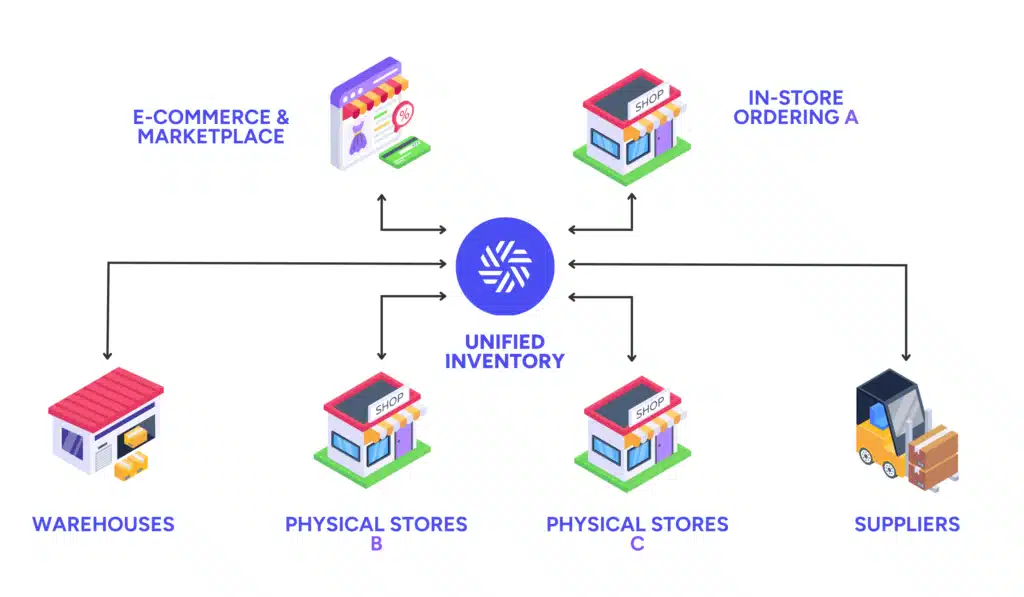
Unified Inventory goes far beyond simple “centralized stock.” It is the ability to visualize and exploit all sources of inventory (warehouses, physical stores, franchisees, suppliers) as a single, dynamic, shared pool in real-time.
Where centralized stock relies on a single warehouse, Unified Inventory relies on a network of connected points of sale, where each store can become a mini-logistics center. It does not require a heavy logistical overhaul, but an intelligent interconnection of existing data.
Imagine a network where every inventory point is linked, offering HQ and the customer a 360° view of availability, the true foundation of Unified Commerce.
3. How a marketplace consolidates Stock Visibility
This is where Origami Marketplace comes in. The solution acts as a central digital hub, aggregating and synchronizing stock feeds from every seller in the network, whether they are your own stores, franchisees, or partners. Each point of sale automatically publishes its availability, feeding a unified and constantly updated database. For the customer, this consolidation translates into a global product offer (Endless Aisle) on the e-commerce site, regardless of where the stock is physically located.
Result: More visible products, fewer stockouts, more sales.
💡 Concrete example: If an item is sold out in the London warehouse, it can be sold and shipped from the Manchester store. This is the promise of connected, agile, and profitable retail.
4. The central role of the OMS (Order Management System)
For Unified Inventory to be effective, you need a pilot brain: the OMS.
The Order Management System decides, for every single order, where the product should ship from based on defined criteria: availability, distance to customer, margin, or store performance. Without an OMS, order allocation remains arbitrary and inefficient.
With Origami Marketplace, this intelligence is natively integrated, removing the need for expensive third-party tools. When a customer places an order, the OMS automatically selects the most relevant store to fulfill it.
You define your own business rules: By geographical zone (Proximity), stock volume (Clearance), historical performance (Reward best stores) & margin objectives. You keep control over the logic, while automating the execution.
Alexandre Duquenoy
→ Book a meeting
5. Benefits for the Customer and the Network
Adopting Unified Inventory via a Network Marketplace creates a virtuous circle for the entire ecosystem.
👉 For the Customer:
- Better Product Availability: The “Endless Aisle” effect.
- Faster Delivery: Via Ship-from-Store or local delivery.
- Convenient Services: Click & Collect (BOPIS), E-reservation, In-store returns.
👉 For the Retail Network:
- Reduced Stockouts and better inventory rotation.
- Fair Sales Distribution across points of sale.
- Valuation of the Store’s Role as a logistical and commercial player.
👉 For the HQ:
- Global Real-Time Vision of inventory.
- Data-Driven Decisions (supply chain, pricing, assortment).
- Centralized and Simplified Management.
6. How Origami Marketplace facilitates Stock Unification
Origami Marketplace is designed to simplify and accelerate the implementation of Unified Inventory thanks to an API-first architecture and modular functional bricks:
- Existing ERP/POS Connectors: Fluid integration with your current systems (no need to rebuild your IT from scratch).
- Integrated OMS: Intelligent and automated order dispatching.
- Intuitive Vendor Interface: Each store manages its availability, prices, and shipments autonomously.
- Real-Time Synchronization: Continuous stock updates to guarantee a flawless customer experience.
With this approach, every store becomes a mini-logistics center, and your e-commerce site transforms into a living showcase of the entire network. All without major technical complexity or integration cost overruns.
🚀 Ready to Unify Your Stock and Boost Sales?
Unifying your inventory is more than a logistical optimization: it is the central lever of Unified Commerce, connecting HQ, stores, and customers in the same digital ecosystem. Discover how Origami Marketplace can unify your network’s inventory: Request a Demo
Want to unify your stocks easily?
Let’s discuss it. Our expertise is not limited to the tool. We help you structure your project with the right method to guarantee its success.
Frequently Asked Questions (FAQ) on Unified Inventory
Centralized stock groups products in a single warehouse, limiting flexibility and increasing delivery times. Unified Inventory, on the contrary, connects all points of sale, warehouses, and partners to exploit them as a global real-time inventory. Each store becomes a mini-logistics center.
No. Our solution acts as an “overlay.” Thanks to our API-first approach and connectors, we plug into your existing ERP, POS, or E-commerce (Shopify, Magento, VTEX…) without requiring a complete overhaul of your Information System.
The marketplace acts as an aggregator. It pulls stock feeds (CSV, API, XML) from every store in real-time and merges them into a single “Master Catalog” displayed on the website. If Store A has 2 items and Store B has 3, the website displays 5 available items.
The main benefit is the Endless Aisle: the product is almost never out of stock. It also enables faster delivery options (Ship-from-Store) and convenient pickup options (Click & Collect).
Yes, it is the perfect use case. Since franchisees own their stock, Unified Inventory allows them to sell it online while keeping the revenue (or paying a commission to the brand). It respects the legal independence of the franchisee while unifying the customer experience.
With Origami Marketplace, a Unified Inventory project can be deployed in 3 to 6 months, depending on the complexity of your existing ecosystem and the responsiveness of your network.
We use “incremental” synchronization (updating only what changed) and “safety stock” buffers (defined thresholds) to prevent selling an item that was just bought physically in-store.
Because you cannot have a unified customer journey (buy anywhere, return anywhere) if your data is siloed. Inventory is the fuel of commerce; unifying it is the first step toward true omnichannel agility.