Ship-from-store: transform your shops into mini-warehouses 🚚

Ship-from-Store : transformer vos magasins en mini-entrepôts

n recent years, delivery has shifted from a simple logistical operation to a major strategic lever for retail brands. Customers are no longer just buying a product; they are buying a promise of speed, flexibility, and transparency.

The ship-from-store (SFS) model responds directly to this challenge by transforming the network of physical stores into a powerful decentralized logistics infrastructure. It is an essential component of digitizing the distribution network, connecting physical points of sale to digital channels to create high-performance omnichannel logistics.

1. Why delivery has become a strategic issue

The explosion of e-commerce, accelerated by the pandemic, has profoundly changed the perception of service. The consumer wants to be delivered fast, to the right place, at the right time. 24-hour delivery, real-time tracking, simplified returns: these standards imposed by e-commerce giants are now the norm.

The cost of the last mile

This famous “last mile” often represents up to 50% of the total delivery cost. Carriers have to manage scattered routes, irregular volumes, and congested urban areas. The result? High costs for the retailer and rising CO₂ emissions.

A paradox for physical retailers

Yet, retailers have a major under-exploited asset: their stores. These points of sale, spread across the entire territory, house inventory that is often dormant, even while central warehouses are saturated.

The key is to connect these stores to e-commerce to fluidify stock and bring the product closer to the customer. This is precisely the role of ship-from-store.

Ready to turn your challenge into a solution?

To help you develop the best platform possible, we’ve gathered all the must-have features, key technical considerations, and best practices in a comprehensive document:

Download the Specifications template 🗒

Perfect for smaller or medium-scale projects without a formal purchasing process. It will help you outline your requirements effectively and streamline your selection process.

Download the Request for Proposal template 📒

Ideal for larger, more complex marketplace projects with a formal purchasing department or advanced procurement policies.

2. The concept of ship-from-store (SFS)

Ship-from-store (SFS) consists of shipping e-commerce orders directly from physical stores rather than from a central warehouse.

How does it work concretely?

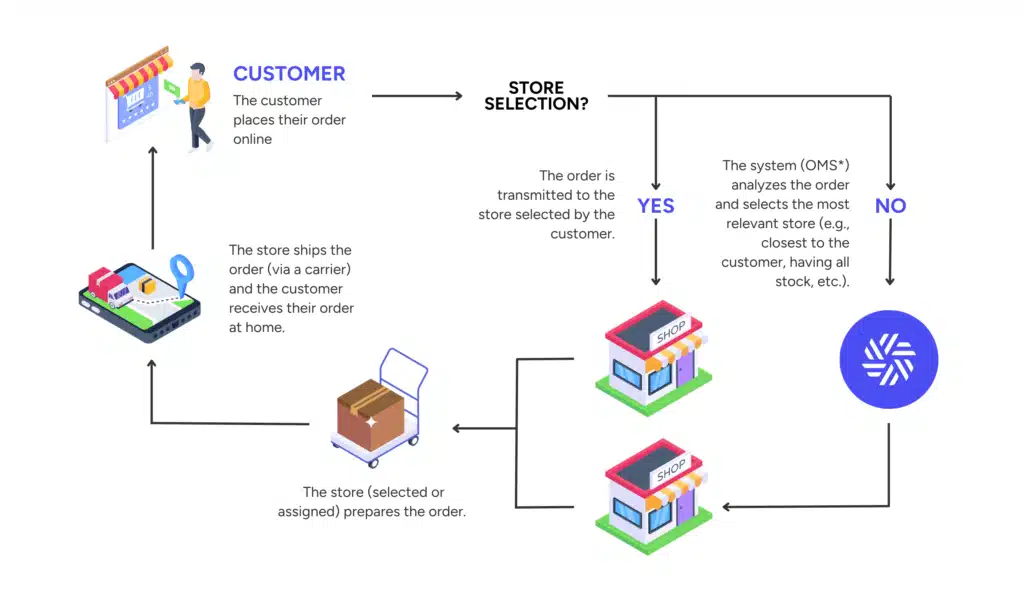
  1. The customer places an order on the website or mobile app.
  2. The order management system (OMS) identifies the most relevant store (proximity, stock, capacity) to process the order.
  3. The order is transmitted to the store, which prepares (picking, packing) and ships the package directly to the customer.
  4. The order is tracked, and returns are managed via the same omnichannel network.
Ship-from-Store workflow example diagram

SFS complements other strategies like click & collect (BOPIS) or return-to-store. It pushes the logic a step further: the store delivers to the customer’s home. It is a key step in digitizing the distribution network, where each point of sale becomes an active and connected logistics brick.

The success of ship-from-store relies on unified inventory and an OMS capable of intelligently orchestrating orders between warehouses, stores, and marketplaces. Without this coherence, the omnichannel promise remains incomplete.

Alexandre Duquenoy

Alexandre Duquenoy

3. The 5 economic and ecological benefits of SFS

Adopting SFS is not just a simple optimization: it is a paradigm shift with multiple benefits.

Benefit Description & Impact
1️⃣ Drastic reduction in logistics costs Shipping from a store close to the customer reduces the miles traveled.
Less distance = less long-haul transport, less fuel, and therefore lighter logistics costs.
2️⃣ Better inventory rotation SFS de-silos stock: a product dormant in a store's backroom can be sold online instead of being marked down.
It’s the end of "dead stock."
3️⃣ Improved customer experience For the customer, the advantage is immediate:
  • Faster delivery (24h, or even same-day in urban areas)
  • Greater product availability
  • Fewer online stockouts
4️⃣ Positive ecological impact By bringing the shipping point closer to the customer, we reduce long-distance trips and associated emissions.
The store becomes a proximity hub serving sustainable logistics.
5️⃣ Measurable and rapid ROI Retailers often observe:
  • • More product availability visible online
  • • Lower transport costs
  • • Fewer delivery delays
  • • Increased omnichannel turnover

4. The 5 technical and organizational conditions for success

Implementing a ship-from-store model cannot be improvised. It rests on five essential pillars.

  1. Unified stock visibility: This is the absolute prerequisite: without unified inventory, ship-from-store is impossible. Each store must share its stock in real-time with the e-commerce platform and the warehouse. This implies a reliable digital inventory and configurable availability thresholds (to keep a “buffer” for in-store sales).
  2. An intelligent OMS (order management system): The OMS is the brain of the operation: it decides which store ships the order based on distance, availability, workload, or margin.
  3. Stores ready for fulfillment: A “fulfiller” store must adapt its organization: dedicated space for picking/packing, staff training, and strict quality processes to avoid errors.
  4. Harmonious coexistence of digital and physical: SFS must never harm the in-store customer experience. This implies intelligent management of flows and schedules (picking before opening, dedicated reserves, etc.).
  5. Omnichannel steering via KPIs: To monitor performance, track: % of orders shipped from stores, average cost per shipment, average delivery time, and preparation error rate.

5. Origami Marketplace’s approach to your SFS project

At Origami Marketplace, we help retailers digitize their distribution network by supporting them from end to end. Ship-from-store is a central lever of this omnichannel transformation.

Our conviction: ship-from-store is not a logistics project, but a lever for digitizing the distribution network. It optimizes costs, fluidifies stocks, and brings the brand closer to its clients.

In a context where speed and sustainability are becoming differentiating factors, ship-from-store stands out as a future-proof model. It reconciles physical and digital around unified and intelligent logistics.

Ship-from-store relies on unified inventory, a high-performance OMS, and successful distribution network digitization.

Do you want to activate ship-from-store in your network?

Discover how Origami Marketplace can transform your stores into high-performance, sustainable mini-warehouses.

Frequently asked questions (FAQ) on ship-from-store

What is the difference between ship-from-store and click & collect?

The fundamental difference lies in where the customer receives the package.

  • Click & collect (or BOPIS – buy online pick-up in store): The customer buys online but travels to the store to pick up their order.
  • Ship-from-store: The customer buys online and is delivered to their home, but the shipment is made from the nearest store, not from the central warehouse.
Does ship-from-store risk disrupting the in-store customer experience?

No, if it is well organized. By using dedicated time slots (e.g., picking before opening) or dedicated staff, SFS becomes an invisible background operation that does not interfere with walk-in customers.

What is the indispensable technical prerequisite for launching SFS?

Real-time stock unification. You must know exactly what is in each store at any given moment to promise it to a web customer. Without this, the risk of cancellation (selling an item that was just bought in-store) is too high.

Is ship-from-store suitable for all retailers?

It is ideal for retailers with a dense network of stores and products that are easy to ship (fashion, shoes, small home goods, electronics). It is more complex for very bulky items (furniture) or networks with very small stores (no space for packing).
How long does it take for ship-from-store to become profitable?

ROI is often very fast (less than 12 months). The savings on “last mile” shipping costs and the reduction in markdowns (by selling dormant stock) generate immediate margin gains.