CNA and AgileBuyer study: four key points to remember for procurement in 2026
- Emeline Kerloch
- 9 minutes de lecture
The 2026 edition of the AgileBuyer x CNA (National Council of Procurement) study represents a significant milestone. While 2025 was a year of experimentation, 2026 is the year of realism. Analysis of the data reveals a paradigm shift: procurement departments are no longer merely seeking to ‘manage the crisis’, but rather to institutionalise resilience through three key strategies: AI-driven productivity, a refocus on CSR, and financial security for supply chains.
1. "AI discount": the new bargaining tool
A 2025 study showed that 40% of buyers were already using AI. By 2026, AI adoption had become a matter of value sharing rather than curiosity.
The increase in regular use to 60% in 2026 comes with a new requirement: cost transparency. Buyers have realised that AI can significantly reduce their suppliers’ structural costs (e.g. back office, design and logistics).
Procurement departments are now demanding “AI discounts”, asking for reductions in suppliers’ operating costs to be reflected in purchase prices. This marks the end of the technological ‘black box’ of service providers.
2. CSR: an unexpected setback?
A shocking figure for the 2026 edition is that, for the first time since 2022, targets for sustainable development are declining.
| CSR Indicator | 2025 edition | 2026 edition |
|---|---|---|
| 🌱 Sustainable development goals | 78% | 69% |
| 💨 CO₂ criteria in supplier selection | 51% | 42% |
The study reveals that, for 34% of survey participants, the need for profitability tends to take precedence over CSR. This may seem counterintuitive in an era of climate change. However, analysis of CNA data reveals a significant shift rather than disengagement.
What this means:
- The end of “green-dating”: by 2025, 57% of buyers had rejected the use of CSR as a justification for price hikes.
- In 2026, strict criteria were introduced and CSR became “punitive” rather than “promotional”. Suppliers were no longer chosen for offering environmentally friendly products, instead, they were rejected if they did not meet basic standards.
- Budgetary arbitration: faced with constant pressure on margins, the “fair price” has taken precedence over the “green price”. Responsible procurement must now demonstrate its economic profitability in the short term (circular economy, reduction in energy consumption).
3. Supplier risks: failures at the highest level
The study found that 65% of respondents were concerned about their partners’ financial health in 2025. These vulnerabilities are indeed a reality: 68,500 business failures were recorded in France in 2025, setting a new record.
What this means:
The procurement function is shifting towards risk management.
- To combat monopolies, which were experienced by 67% of buyers in 2025, procurement departments in 2026 are investing heavily in diversification through systematic multi-sourcing.
- Sovereignty and relocation: the study confirms that ‘Made in France’ remains a complex aspiration. While the intention is there, cost is holding back the move.
In 2026, relocation will be targeted: it will only concern critical components where the risk of disruption is deemed unacceptable.
| Perceived risk | 2025 | 2026 (projection) |
|---|---|---|
| 🙅 Financial failure | 65% | High stagnation, critical risk |
| 🥷 Cyberattacks | 42% | Increase due to AI integration |
| 👎 Monopolies | 67% | Attempt to reduce via multi-sourcing |
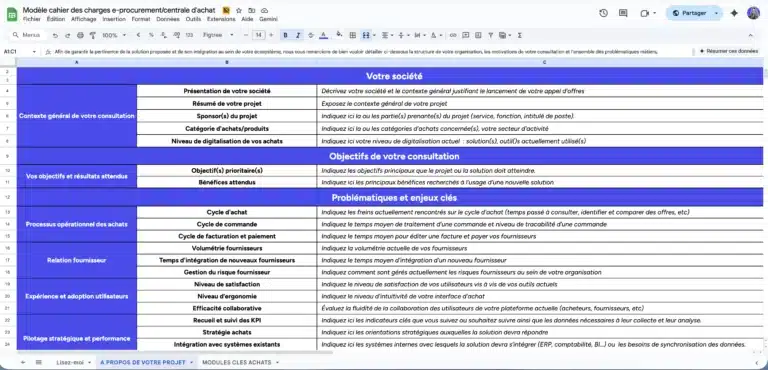
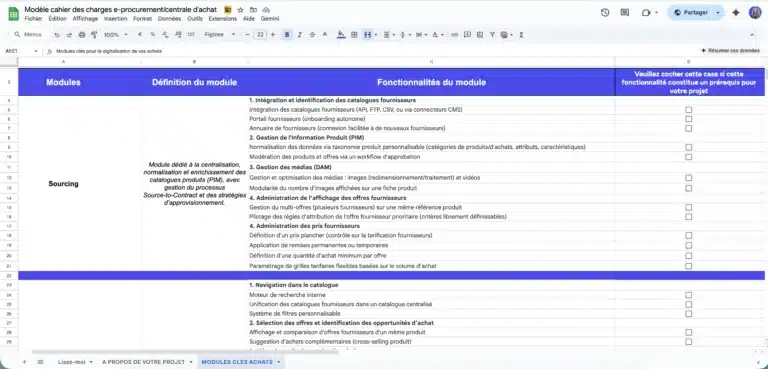
Download our free marketplace specifications template.
Here you will find all the essential features to succeed in your B2B multi-vendor marketplace. This model provides a simple backlog to guide you through each step of your project.
4. Prioritising costs: the strong comeback of "saving"
Although inflation has stabilised, buyer psychology in 2026 is still influenced by the period from 2023 to 2024. The objective of reducing costs, a priority for 77% of management teams, has become more technical.
Buyers are no longer content to simply ask for a discount. They now perform cost breakdown analyses. In 2026, procurement performance will be measured by a buyer’s ability to understand a supplier’s cost structure better than the supplier does itself.
“The buyer of 2026 is not just a price negotiator; they are a value engineer. They must balance immediate profitability with the long-term survival of their supply chain.”
– Summary of the AgileBuyer/CNA study.
5. Expert analysis: Why is the marketplace the answer to the challenges of 2026?
"The 2026 AgileBuyer x CNA study confirms that, rather than being mere price negotiators, buyers are now orchestrators of ecosystems. In the face of monopolies in 67% of situations and a demand for 'hard savings' affecting 77% of management teams, the private marketplace is not just a technological option, but a strategic necessity. It automates the capture of AI-related productivity gains and industrialises 'multi-sourcing' so that companies are no longer held hostage by a single supplier."
Julien Bruitte, CEO of Origami Marketplace
The Origami Marketplace experts have broken down the three key findings of the study from the platform’s perspective:
Turning “AI discounts” into operational reality
The 2026 study highlights that buyers want their suppliers to provide them with the productivity gains of AI: “to require AI-related price reductions, you need to be able to compare in real time. The marketplace centralises data from hundreds of suppliers. This enables the implementation of dynamic pricing algorithms that instantly compare cost structures. Without a centralised platform, buyers are unable to verify whether their suppliers are actually passing on their technological gains.”
Breaking monopolies through controlled “self-service”
One of the most striking findings of the study is the prevalence of monopolies (67% of respondents).
“Monopolies are often the result of purchasing habits or administrative inertia, such as overly complex onboarding processes. By deploying an internal marketplace, a procurement department can integrate dozens of innovative or local SMEs in just a few clicks. In 2026, marketplace technology will enable the risk to be spread by offering employees a broad but pre-validated catalogue, thereby breaking their dependence on traditional “big” suppliers.”
CSR: moving from rhetoric to “transactional” data
The decline in CSR (from 78% in 2025 to 69% in 2026) shows a need for tangible proof of profitability. “If CSR is declining, it is because it was too declarative and not sufficiently integrated into the procurement process. On a marketplace, carbon scores or proximity criteria are not optional extras in an annual report, they are search filters. In 2026, the only way to maintain CSR objectives in the face of cost pressures will be to make them “invisible” and automatic in the digital purchasing process.”
Conclusion: towards an era of "strategic sobriety"?
Between 2025 and 2026, the procurement function is expected to become more mature, less idealistic and more influential. By integrating AI into contracts, streamlining corporate social responsibility (CSR) initiatives, and safeguarding financial flows, buyers are establishing themselves as the true guarantors of companies’ operating margins.
Ready to transform your procurement with the marketplace?
Accelerate your project by calling on a specialist provider such as Origami Marketplace. Find out how our innovative solution, based on the marketplace model, can transform your business, whatever its size, thanks to our API and partner network.