Top 10 Best Procurement Software: Comparison & Guide 2026
- Arnaud
- 8-minute read
Executive Summary:This guide compares the 10 market-leading solutions to digitalize your procurement in 2026, from sourcing to payment. We also present an innovative alternative to transform your purchasing into a profit center: the marketplace model.
Procurement management is undergoing a major transformation. Between manual workflows, validations dragging on for weeks, and missing invoices, Excel is no longer enough. For CFOs, purchasing managers, and operational departments, digitalization is no longer an option: it is a strategic performance lever. But with the proliferation of Procure-to-Pay (P2P), Source-to-Pay (S2P), and Procurement ERP solutions, how do you choose the best procurement software for your organization?
1. What is procurement management software?
Procurement software (or Procurement IS) is a digital solution that centralizes and automates the entire lifecycle of corporate spending. It acts as the link between:
- Operational staff (who express needs).
- Buyers (who negotiate).
- Finance teams (who control and pay).
We generally distinguish two functional scopes:
- P2P (Procure-to-Pay): From the purchase requisition to the invoice payment.
- S2P (Source-to-Pay): Encompasses P2P while adding sourcing, tendering (RFPs), and contract management.
The key objective: Do not suffer the expense, but steer it in real-time with the right procurement solution.
2. Why equip yourself with procurement software?
Beyond eliminating paper, a good tool offers 5 immediate benefits:
- ✔ Reduce errors and duplicates: Thanks to automatic purchase order/invoice matching.
- ✔ Save time: Automatic entry via OCR, purchase order generation in 1 click.
- ✔ Budgetary visibility: Access to committed expenses vs. budget in real-time.
- ✔ Strengthen compliance: Reliable audit trail, VAT compliance, and preparation for the 2026 electronic invoicing mandate.
- ✔ Better negotiation: Centralizing data allows you to analyze your purchasing volumes to obtain better prices.
3. The 5 key missions of a high-performance Procurement IS
To be effective, your tool must cover these essential bricks:
- Supplier Management (SRM): Data centralization, KYS (Know Your Supplier), and risk assessment.
- Sourcing & Contracts: Management of tenders (RFP/RFQ) and contract lifecycles.
- Requests & Orders: Internal catalogs (e-commerce style), approval workflows, and order dispatch.
- Invoice Processing: Intelligent capture (OCR + AI), automatic “Okay to Pay,” and accounting export.
- Analysis & Reporting: Spend Analysis dashboards.
4. Top 10 Best Procurement Software (2026 Comparison)
Here is the summary of the forces at play before the detailed analysis.
| Solution (Estimated) | Functional Specificities | Advantages (Human, Deployment, Support) | Target | Rates |
|---|---|---|---|---|
| SAP Ariba |
|
|
Mid-caps, Key Accounts | By quote |
| Yooz |
|
|
SMEs, Mid-caps | By quote |
| Corcentric |
|
|
Large SMEs, Mid-caps, Key Accounts | By quote |
| Coupa |
|
|
Mid-caps, Key Accounts | By quote |
| Libeo |
|
|
VSEs, SMEs, Mid-caps | From €99/mo |
| Weproc |
|
|
SMEs, Mid-caps | By quote |
| Ivalua |
|
|
Mid-caps, Key Accounts | By quote |
| Oxalys |
|
|
SMEs, Mid-caps | From €190/mo |
| Sourcing Force |
|
|
SMEs | From €80/mo |
| Procurify |
|
|
SMEs, Mid-caps | From $35/user/mo |
| Origami Marketplace |
|
|
Central Purchasing Bodies, Mid-caps, Large Groups | By quote (Flexible model: Sub +) |
This comparison was made based on public information and pricing available in Q4 2025. As the procurement software market evolves rapidly, this data is indicative and subject to change by the publishers. The prices displayed generally correspond to an entry-level or average estimate.
The global powerhouse for sourcing and procurement. SAP Ariba connects you to the world’s largest B2B network, facilitating collaboration between buyers and suppliers. It covers the entire Source-to-Pay cycle with robust automation and international compliance capabilities.
- Why choose it? For its unrivaled international supplier network and deep native integration with the SAP ecosystem.
- Ideal target: Mid-caps and Key Accounts.
The champion of automated invoice processing. Yooz leverages AI and Deep Learning to automate the P2P process, from purchase requisition to payment. It is particularly renowned for its ability to eliminate manual data entry and ensure tax compliance.
- Why choose it? For its powerful OCR technology, tax compliance management, and ease of deployment.
- Ideal target: SMEs and Mid-caps.
A comprehensive suite for optimizing cash flow and procurement processes. Corcentric offers a modular approach (Source-to-Pay, Order-to-Cash) with strong capabilities in managing complex catalogs (punch-out) and advanced validation workflows.
- Why choose it? For its “human-first” support and rigorous deployment methodology that ensures high adoption.
- Ideal target: Large SMEs, Mid-caps, and Key Accounts.
The leader in “Business Spend Management” (BSM). Coupa provides total visibility over all organizational spend (procurement, invoicing, expenses). Its user-centric platform focuses on adoption to capture maximum data.
- Why choose it? For its predictive analysis features, risk management, and the “Coupa Open Buy” marketplace.
- Ideal target: Mid-caps and Key Accounts.
The all-in-one solution to pay suppliers in one click. Libeo radically simplifies the invoice-to-pay cycle. The platform centralizes invoices and allows them to be paid directly without going through the banking interface, all while integrating with accounting.
- Why choose it? For its disconcerting simplicity, its integrated payment (IBAN/Scan), and its modern interface.
- Ideal target: VSEs, SMEs, and Mid-caps.
SaaS procurement made simple. Weproc streamlines the purchase requisition process with customizable workflows and real-time budget tracking by project. It is designed to remove friction between operational staff and finance teams.
- Why choose it? For its intuitive interface that requires almost no training and its quick setup.
- Ideal target: SMEs and Mid-caps.
A highly configurable platform for strategic sourcing. Ivalua excels in managing complex spend and supplier relationships (SRM). It offers a unified suite that covers all spend categories (direct and indirect).
- Why choose it? For its flexibility, advanced supplier risk management, and depth in strategic sourcing.
- Ideal target: Mid-caps and Key Accounts.
The pragmatic solution for digitizing the entire procurement cycle. Oxalys allows for the management of multi-entity structures and automates validation circuits efficiently. It is a flexible tool that adapts to the specific processes of mid-sized organizations.
- Why choose it? For its quick implementation, dedicated support, and ability to handle multi-entity management seamlessly.
- Ideal target: SMEs and Mid-caps.
A user-friendly cloud solution for paperless procurement. Sourcing Force simplifies quote management (B2B e-procurement) and order processing, offering centralized visibility over expenses by cost center.
- Why choose it? For its simple deployment and efficient management of quotes and orders.
- Ideal target: SMEs.
Spend management with a focus on speed and culture. Procurify offers real-time budget visibility and a mobile-friendly experience. It empowers team members to request what they need while giving finance teams control.
- Why choose it? For its collaborative supplier portal, clear documentation, and proactive spend controls.
- Ideal target: SMEs and Mid-caps.
Don’t miss anything in your S2P RFP.
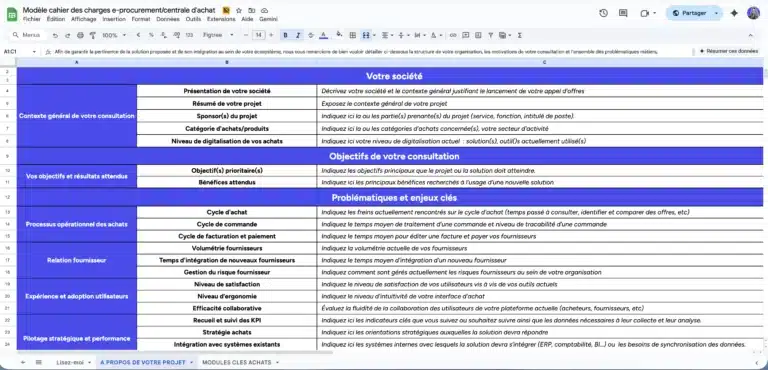
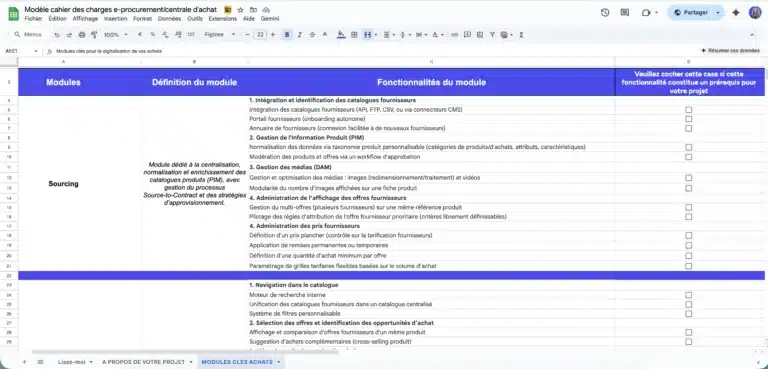
A ready-to-use Excel template to structure your eProcurement / S2P RFP, align stakeholders, and objectively compare vendors.
Excel format • Ready to customize • Built for real-world sourcing teams
5. The Strategic Alternative: Origami Marketplace
The 10 software solutions above aim to optimize existing processes. But another approach allows you to reinvent your procurement strategy: the B2B Marketplace model. This is where Origami Marketplace comes in.
A different vision
Instead of simply managing suppliers one by one, Origami allows you to create your own intermediation platform (your internal or public “Amazon Business”).
- For whom? Central purchasing bodies, Multi-subsidiary groups, Franchises, Key accounts with complex catalogs.
- The mechanism: You aggregate thousands of third-party vendors on a single interface. Orders are centralized, but stocks and shipments can be managed by the vendors (Dropshipment).
The key benefit: Transforming procurement into a profit center
Where classic software is a cost center, Origami Marketplace’s procurement solution allows you to generate revenue:
- By taking commissions on third-party supplier sales.
- By monetizing access to your marketplace.
- By drastically reducing the management costs of “small suppliers” (Tail Spend).
Conclusion: Which tool to choose?
The “best” procurement software is the one that aligns with your digital maturity:
- Are you an SME? Aim for simplicity and rapid adoption with Pivot, Precoro, or Flowie.
- Are you a Mid-cap/Key Account? Secure your complex flows with Corcentric, Oxalys, or Ivalua.
- Do you want to monetize your ecosystem? Step out of the classic framework and study the marketplace approach with Origami Marketplace.
And now? Start by auditing your current processes to define your priority needs and the different procurement solutions available.
Ready to digitalize your procurement?
Let’s discuss it. Our expertise is not limited to the tool. We help you structure your project with the right method to guarantee its success.

Frequently Asked Questions (FAQ) on Procurement Software
ERPs often possess a procurement module, but it is frequently judged as rigid and unintuitive by users. A specialized software (called “Best-of-breed”) offers a better user experience (e-commerce style), advanced features (OCR, AI, Sourcing), and connects easily to your ERP to retrieve only the accounting entries. Team adoption is often much better on a dedicated tool.
The price varies greatly depending on the scope (P2P vs S2P) and the deployment model.
- For SMEs (SaaS): Entry-level solutions start between €80 and €200 per month.
- For Mid-caps/Large Groups: Budgets are customized (By quote) and include setup fees (integration, configuration) + annual licenses based on the number of users or spend volume. Count on €30k to €100k+ for a complete project.
- e-Procurement: Works on a linear model. You negotiate with a supplier, buy the stock (or validate the order), and manage the flow. It is ideal for strategic suppliers (Class A purchases).
- B2B Marketplace: Works on a platform model. You connect buyers (your employees or subsidiaries) directly with a multitude of third-party vendors via a unified portal. The marketplace operator acts as a trusted intermediary. This is ideal for managing long-tail procurement (Class C purchases) and reducing administrative burdens.