2025 procurement & supply barometer: consolidation time for B2B marketplaces

baromètre achats & supply 2025 - origami marketplace

As 2025 comes to an end, the landscape of B2B procurement has undergone a transformation. The phase of forced adoption post-Covid is now behind us, giving way to an era of industrial rationalisation.

By cross-referencing data from major industry bodies (FEVAD, Gartner, CNA, McKinsey), one reality becomes clear: the B2B marketplace is no longer just a digital alternative to wholesalers. It has become the dominant infrastructure for managing the growing complexity of supply and regulatory pressure (CSRD, CSR).
Here are the four pillars that will define procurement strategy in 2025.

1. Digital-first is the new norm in supplier relationships.

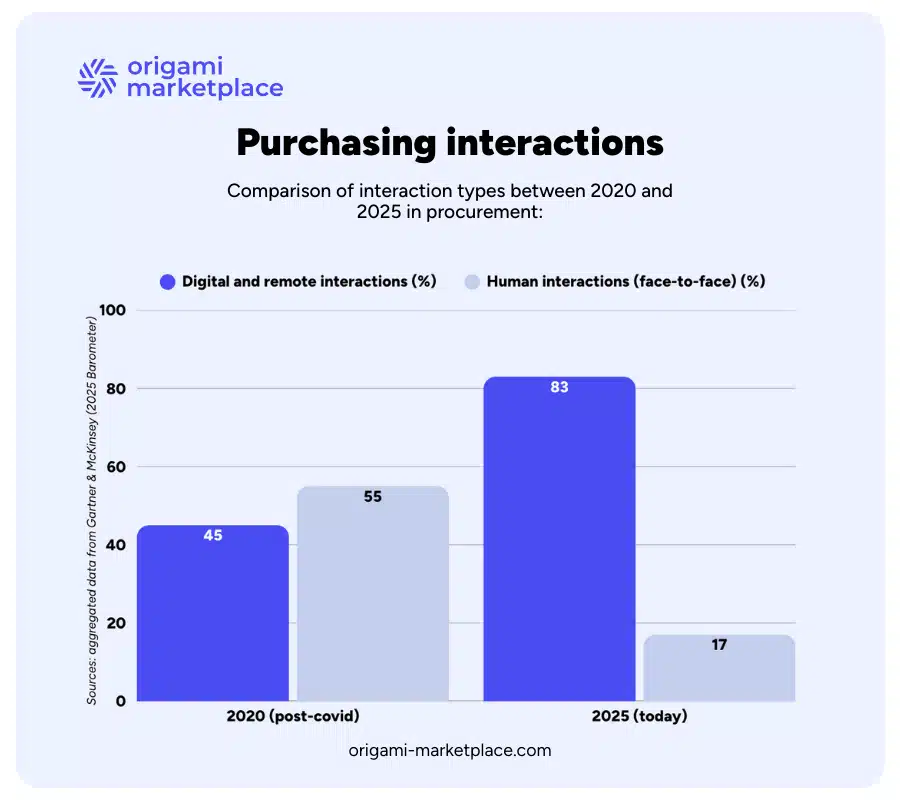
A few years ago, Gartner made a bold prediction: “by 2025, 80% of B2B sales interactions will take place on digital channels.”

Here we are. Studies from 2024 confirm this massive shift. B2B buyers now favour self-service digital channels, relegating traditional human interaction (sales representatives in the field) to complex purchases only.

Key figures regarding the digitisation of procurement:

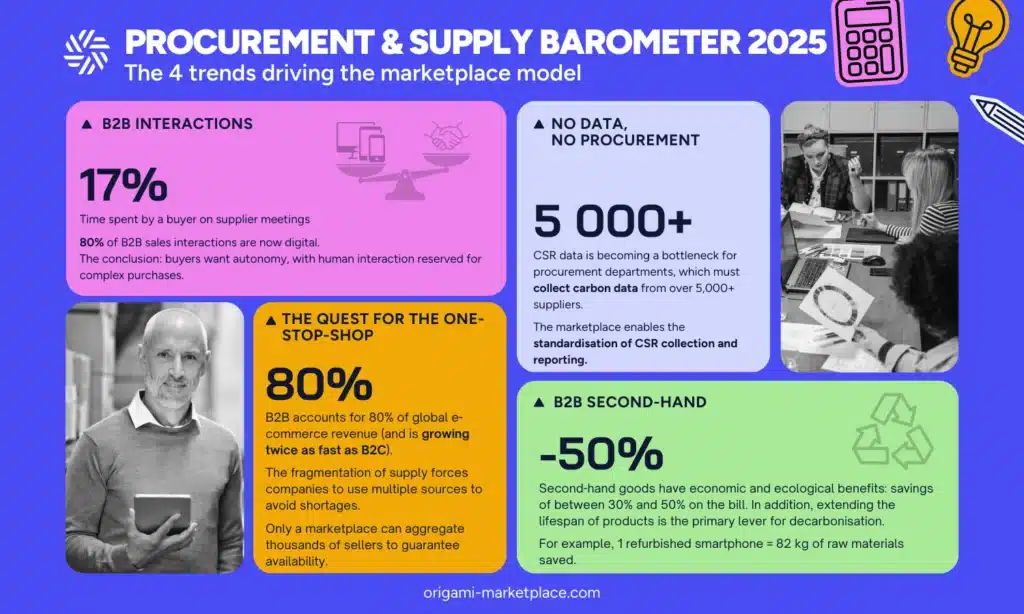
  • 17%: the amount of time a buyer spends on supplier meetings (Gartner).
  • 57%: the proportion of decision-makers who approve a purchase without any human interaction (McKinsey).
  • 87%: the percentage of buyers who demand an autonomous purchasing process (McKinsey).

Market analysis: companies that have not adapted their organisation to this paradigm are experiencing an explosion in their acquisition costs. In 2025, the most effective “salesperson” is often an internal search engine coupled with intelligent recommendations. The omnichannel approach remains vital (website, e-procurement, chat), but humans are now exclusively reserved for high added value.

2. B2B e-commerce: the answer to supply fragmentation

According to the latest report from FEVAD, the B2B sector continues to drive growth in French e-commerce, outperforming B2C for the third consecutive year.

Faced with the risk of shortages that marked the beginning of the decade, securing supplies has become vital. Companies must diversify their sources (multi-sourcing) to avoid disruptions.

Why is the marketplace model becoming the norm?

The one-stop-shop model is the Holy Grail for purchasing departments. However, technically, only the marketplace model can make this a reality.

  • Turnover: more than €175 billion in business-to-business transactions are carried out via e-commerce in France (ecommerceeurope.eu).
  • Growth: the global B2B market grew by +14.4% in value between 2024 and 2025 (capitaloneshoping).
  • Adoption: 88% of B2B buyers make at least one purchase per year on a marketplace (capitaloneshoping).

By aggregating thousands of third-party sellers, the platform guarantees near-immediate availability and competitive prices. Not being connected to these ecosystems in 2025 means cutting yourself off from the main flow of business-to-business commerce.

comparison on procurement interactions between 2020 and 2025

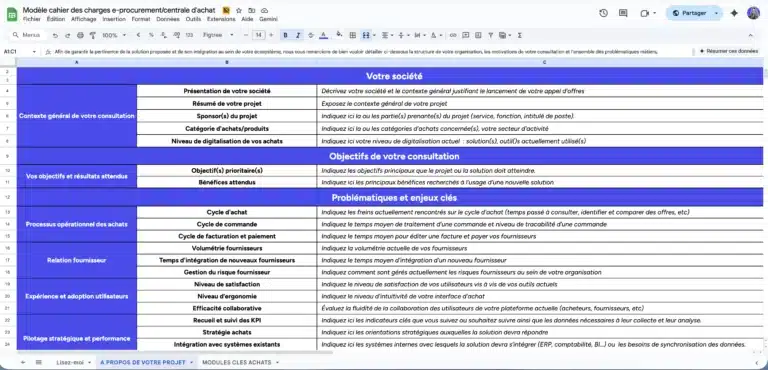
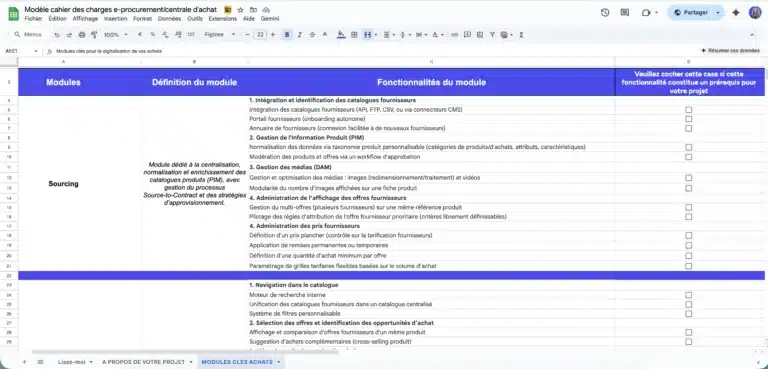
Download our specifications template free of charge.

Find all the essential features you need to make your B2B marketplace a success. This template provides you with an easy-to-use backlog to guide you through every stage of your project.

3. CSR : from "nice-to-have" to "licence to operate"?

This is the tipping point of 2025. Under the influence of European regulations (CSRD), procurement departments are transforming themselves into collectors of non-financial data.

CSR compliance is no longer a marketing slogan, it is a necessary step to avoid penalties or exclusion from certain markets. According to the Conseil National des Achats (CNA) and AgileBuyer, supplier risk management and CSR are now among the permanent priorities of purchasing directors, alongside the sacrosanct reduction of costs.

The challenge of collecting supplier data (scope 3)

How can you calculate your carbon footprint (scope 3) with more than 5,000 suppliers? Manual collection via Excel has reached its limits and creates an operational bottleneck.

The technological solution: a centralised platform. B2B marketplaces are emerging as the only tools capable of standardising this collection on a large scale.

  • Centralisation: a single channel where suppliers submit their CSR certificates and scores.
  • Standardisation: consistent data to facilitate CSRD reporting.
  • Traceability: detailed management of supplier risk and sustainability.

More than half of large companies say they are prepared to change suppliers if data traceability is not guaranteed.
4. The explosion of B2B second-hand and refurbished goods

The market for second-hand professional equipment is the big winner in the current inflationary climate. For IT, office, furniture and industry, circularity has become a major economic and ecological lever.

Why will B2B refurbishment take off in 2025?

According to ADEME, extending the life of equipment is the most powerful lever for reducing carbon footprints.

  • Ecological impact: a refurbished smartphone avoids the extraction of 82 kg of raw materials (Banque des Territoires).
  • Economic impact: savings of 30 to 50% compared to new equipment.
  • Increased confidence: professionalisation of players (12-month warranties, standardised aesthetic grades, after-sales service).

B2B marketplaces now integrate new and refurbished products on the same interface, allowing CIOs and buyers to compare and choose rationally. The circle is complete: reuse is fully integrated into the procurement strategy.

Conclusion: the marketplace as a tool for resilience

Digitalisation, fragmentation of supply, CSR, emergencies, inflation… Faced with these complex requirements, a single supplier is no longer enough.

The B2B marketplace is no longer just a sales channel, it is the nervous system that ensures the resilience of the supply chain. It offers the flexibility needed to:

  • Multiply sources without multiplying efforts.
  • Ensure CSR compliance (CSRD).
  • Integrate the circular economy.

In 2025, having a flexible procurement platform will no longer be a competitive advantage, but a condition for survival for modern businesses.

No time to read the article? Check out the infographic summary.

procurement & supply barometer 2025 - origami marketplace

👉 Need a turnkey solution? Call on a specialist provider, such as Origami Marketplace, to accelerate your project. Discover how our API and our network of partners can transform your business, whatever its size, thanks to our innovative solution based on the marketplace model.